Email your objection to [email protected] before midnight as Sunday, July 12 turns into Monday, July 13.
Deadline shown in Pacific time.
Two days after the Fourth of July, the question before America is not merely whether religion should be honored in public life. It should be. The question is whether religious liberty is best protected by joining church and state together, or by keeping civil power from possessing the conscience.
The Religious Liberty Commission’s report is right to identify a real danger. Religious citizens should not be told to leave their convictions at home when they enter a school, a workplace, a hospital, or the public square. Secularism is not neutral when it becomes an ideology that silences religious conviction. A government that excludes faith from public life is not protecting freedom.
But the Commission’s proposed remedy risks exchanging one form of coercion for another. If secular power should not dominate religion, religious power should not be invited to use the machinery, money, and symbols of the state.
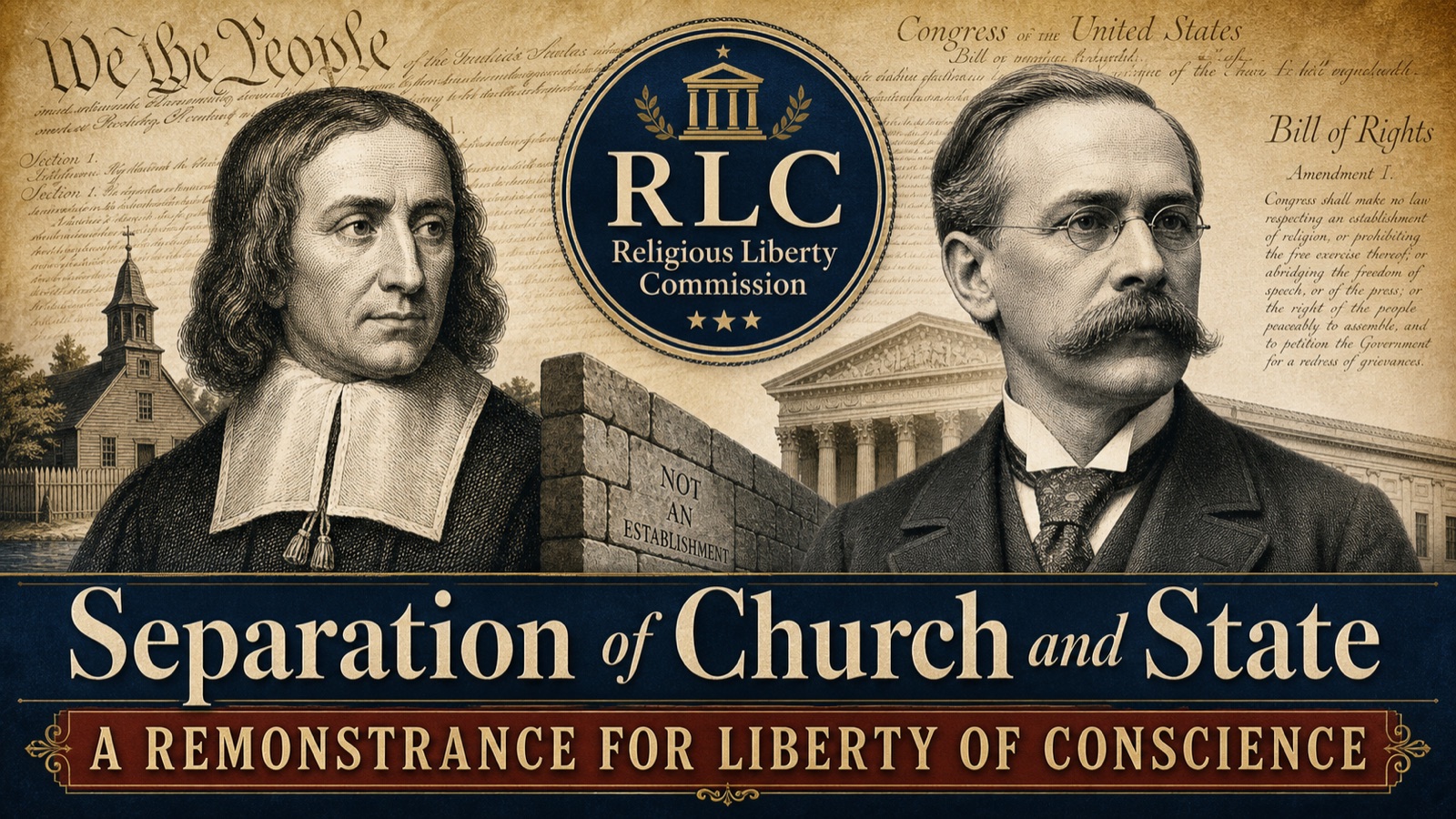
The matter is plain: the Commission’s draft report weakens the separation of church and state, and any union of church and state finally leads to false worship and oppression. The wall of separation was not a secular invention imposed upon religion. It was built by people of faith to protect faith. Roger Williams, dissenting Baptists, Madison, Jefferson, and the long American struggle for disestablishment all testify that religion flourishes most safely when church and state cannot possess one another.
A. T. Jones made the same argument in his 1898 address, What is Patriotism in the United States? Jones defined the patriot as “any defender of liberty, civil or religious.” For him, patriotism in America meant allegiance to the principles that keep religion outside the control of government. This was not because religion is unimportant, but because it is too sacred to be governed by civil power.
Jones argued that government receives its just powers from the consent of the governed, while religion concerns a person’s duty to the Creator. No government can answer to God for an individual soul. Therefore, no government has rightful authority to define, fund, prefer, or direct religion.
That distinction matters now. The Commission objects that the phrase “separation of church and state” has sometimes been misused to drive faith from public life. That misuse should be corrected. But the answer is not to discard the wall. The better distinction is this: there must be no wall between a religious citizen and public participation, but there must remain a wall between ecclesiastical power and civil power.
That wall protects the believer. It protects the unbeliever. It protects the minority church. And it protects the church that refuses to sell its witness for public favor.
This is why the report’s support for expanded public funding of religious organizations and religious education is so troubling. Public money brings public control. Once government funds religious work, government must decide which religious work qualifies, which doctrines may be supported, what counts as education, and which religious conditions are acceptable. The state is then drawn into the very role it should never occupy: judge of religious truth and usefulness.
Jones warned against public money being paid to churches or religious institutions under any pretext. Such support may appear friendly to religion at first, but it makes religious work dependent on political favor. A church that lives by state patronage will eventually be tempted to adjust its witness to keep that patronage.
The same danger appears in government religious displays and Sunday-law reasoning. When the state borrows religious language, it must choose among religious interpretations. Which numbering of the Ten Commandments? Which Sabbath? Which tradition’s public theology? A government that posts or enforces religious symbols may claim to honor faith, but in practice it begins to settle religious questions that belong to conscience and to the churches themselves.
The Commission should also reconsider its recommendation regarding the Johnson Amendment. Churches must be free to preach morality, criticize injustice, defend life, plead for mercy, and speak to the great questions of the day. But converting tax-exempt churches into vehicles for partisan endorsements would bring political money, campaign pressure, and factional discipline into the sanctuary.
The church does not need permission to become a campaign arm. It needs freedom to remain a moral and spiritual witness.
The Commission has identified a real danger: a secularism that would crowd religion out of public life. But the American answer is not an alliance of church and state. Tocqueville observed that religion in America gained its peaceful ascendancy because Americans credited it to the complete separation of church and state. Lyman Beecher, who once feared Connecticut’s disestablishment, later called it the best thing that happened to the churches because it threw them upon their own resources and upon God.
Two days after Independence Day, this is the patriotic question: will America protect religion by keeping it free, or will it try to honor religion by placing it under political management?
A. T. Jones would have answered that true patriotism defends religious liberty by keeping the civil power out of religion. That remains the safer answer. That remains the American answer.
The Commission should revise its historical account and withdraw or substantially modify recommendations that would diminish the separation of church and state, expand public funding of religious activity, support government religious displays, or repeal the Johnson Amendment. Religious liberty is not protected by giving government more religious authority. It is protected by defending liberty of conscience for all. If you share these concerns, add your name to the Freedom Sentinel remonstrance petition and email your objection to the Commission at [email protected] before the public comment window closes. Let the record show that Americans who cherish faith also cherish the wall that keeps faith free.
What the Commission proposes to send to President Trump
In Appendix B, the report identifies “12 Key Recommendations” and then expands them into detailed recommendations. Among the proposals most relevant to church-state separation are:
Instruct the Department of Justice to issue guidance clarifying the “proper understanding” of the Establishment Clause and separation of church and state. Draft report, p. 200
Create a DOJ Religious Liberty Task Force and establish Conscience and Religious Freedom Divisions across the federal government. Draft report, pp. 201, 208-210
Expand partnerships, grants, funds, and contracts for faith-based institutions on an equal basis with secular groups. Draft report, pp. 203, 214
Repeal the Johnson Amendment; until then, issue Treasury guidance narrowing it and support DOJ litigation challenging it. Draft report, pp. 201, 220
Promote universal school choice and challenge restrictions that prevent school-choice funds from being used at religious schools. Draft report, pp. 214, 219
Support religious expression in public schools, including religious clubs, religious materials, release-time religious instruction, student-led prayer, voluntary prayer/chaplain programs, and litigation supporting Ten Commandments and world-religion posters. Draft report, pp. 215-216
Continue official recognition of America’s religious heritage through presidential proclamations, calls to prayer and fasting, national religious memorials, and restored religious displays in military and VA settings. Draft report, p. 204
Restore or compensate service members affected by COVID-19 vaccine religious objections and pursue litigation over denied vaccine religious exemptions. Draft report, pp. 202, 222
The political temperature in America, already hot, has increased to a boil following the assassination attempt on former President Trump. The stunning (and thankfully unsuccessful) attempt has served to galvanize the right, bringing a unity improbable a few short weeks ago.
It is not hard to understand why. Trump is not only beloved by many, but the sustained opposition on various fronts have led his followers to believe that he is the target of the ‘deep state’. There is a strong sense among some, even those who were not ardent Trump supporters, that it is possible that the attempt on his life was something more than a lone gunman on a slanted roof that was “accidentally” unsecured by Kim Cheatle’s (and Alejandro Mayorkas’s) Secret Service.
Most recently, at the 2024 National Conservatism Conference and five days before the attempted assassination, Senator Josh Hawley claimed (incorrectly) that America was founded in the tradition of Augustine as carried on by “stern Puritans”, and stated:
“And I’m sure some will say now I am calling America a Christian nation. And so I am. And some will say that I am advocating for Christian Nationalism. And so I do.”
Senator Hawley’s assertions are false, and Americans of all political and religious persuasions need to understand they are false.
Most of the Founding Fathers were not Puritans, nor could any sort of viable argument ever be made that they were. George Washington, James Madison, Thomas Jefferson, John Adams, Benjamin Franklin: none of them were Puritans, nor were they followers of Augustine. Far from it.
Augustine of Hippo was born in 354 AD, died in 430 AD, and repeatedly advocated for torture and forced conversion.6Augustine’s Letters #185 Ch.6: “It is indeed better (as no one ever could deny) that men should be led to worship God by teaching, than that they should be driven to it by fear of punishment or pain; but it does not follow that because the former course produces the better men, therefore those who do not yield to it should be neglected. For many have found advantage (as we have proved, and are daily proving by actual experiment), in being first compelled by fear or pain, so that they might afterwards be influenced by teaching, or might follow out in act what they had already learned in word.”7Augustine’s Letters #185 Ch.6: “Why, therefore, should not the Church use force in compelling her lost sons to return, if the lost sons compelled others to their destruction? Although even men who have not been compelled, but only led astray, are received by their loving mother with more affection if they are recalled to her bosom through the enforcement of terrible but salutary laws, and are the objects of far more deep congratulation than those whom she had never lost. Is it not a part of the care of the shepherd, when any sheep have left the flock, even though not violently forced away, but led astray by tender words and coaxing blandishments, to bring them back to the fold of his master when he has found them, by the fear or even the pain of the whip, if they show symptoms of resistance; especially since, if they multiply with growing abundance among the fugitive slaves and robbers, he has the more right in that the mark of the master is recognized on them.” His tyrannical views on the subject formed the basis of both the Crusades carried out by the Roman Catholic Church and the Inquisition, including the torture and murder of supposed Protestant “heretics”. https://churchandstate.org.uk/2016/04/the-dark-side-of-christian-history-the-inquisition-and-slavery/[/mfn]
Augustine was opposed to liberty of conscience, not in favor of it. Augustine, if he were alive, would have been opposed to the Declaration of Independence, and the First Amendment to the U.S. Constitution.
In contrast, the Founding Fathers passionately believed in liberty of conscience and were fiercely opposed to state coercion on religious grounds. This was the foundation of America – a land for all, without king or Pope, where no religious zealot could use the power of the state to impose his creed on his fellow men.
Senator Hawley stated the following in the same speech:
Twenty thousand practicing Augustinians made their way to these shores to found a society here on his principles. History knows them as the Puritans. Inspired by the ‘City of God’ they founded “The City On a Hill”. We are a nation forged from Augustine’s Vision a nation defined by the Dignity of the Common Man.8https://www.youtube.com/watch?v=tgNbGxdDZ2I?t=260
Again, Senator Hawley’s comments are demonstrably false. America was not “forged on Augustine’s vision”, but was founded most decidedly in opposition to Augustine’s tyrannical ideas. The Founding Fathers speak for themselves.
James Madison stated the following regarding liberty of conscience and religious freedom:
That Religion or the duty we owe to our Creator, and the manner of discharging it, being under the direction of reason and conviction only, not of violence or compulsion, all men are equally entitled to the full and free exercise of it according to the dictates of Conscience.9https://founders.archives.gov/documents/Madison/01-01-02-0054-0003
James Madison, Amendments to the Virginia Declaration of Rights, June 1776
…
It is the duty of every man to render to the Creator such homage and such only as he believes to be acceptable to him. This duty is precedent, both in order of time and in degree of obligation, to the claims of Civil Society.10https://founders.archives.gov/documents/Madison/01-01-02-0054-0003
James Madison, Memorial and Remonstrance Against Religious Assessments, circa June 20, 1785
We are teaching the world the great truth that Governments do better without Kings and Nobles than with them. The merit will be doubled by the other lesson that Religion Flourishes in greater purity, without than with the aid of Government.12https://founders.archives.gov/documents/Madison/04-02-02-0471
James Madison, letter to Edward Livingston, July 10, 1822
In the fight to pass the Virginia Bill for Religious Liberty, Madison remonstrated with that generation’s version of “Christian Nationalists” who tried to insert the words “Jesus Christ” in a preamble. Madison stated, “The better proof of reverence for that holy name would be not to profane it by making it a topic of legislative discussion…”13https://founders.archives.gov/documents/Madison/04-01-02-0549
Benjamin Franklin stated, “When a religion is good, I conceive it will support itself; and when it does not support itself so that its professors are obliged to call for the help of the civil power, ’tis a sign, I apprehend, of its being a bad one.”
George Washington, in a letter to Touro Synagogue to assure the religious freedom of the Jews in the U.S., stated:
The Citizens of the United States of America have a right to applaud themselves for giving to Mankind examples of an enlarged and liberal policy: a policy worthy of imitation…It is now no more that toleration is spoken of, as if it was by the indulgence of one class of people that another enjoyed the exercise of their inherent natural rights. For happily the Government of the United States, which gives to bigotry no sanction, to persecution no assistance, requires only that they who live under its protection, should demean themselves as good citizens.
May the Children of the Stock of Abraham, who dwell in this land, continue to merit and enjoy the good will of the other Inhabitants; while every one shall sit in safety under his own vine and figtree, and there shall be none to make him afraid. May the father of all mercies scatter light and not darkness in our paths, and make us all in our several vocations useful here, and in his own due time and way everlastingly happy.14https://founders.archives.gov/documents/Washington/05-06-02-0135
George Washington, Letter to the Hebrew Congregation in Newport, Rhode Island, Aug. 18, 1790 in: The Writings of George Washington, p. 766-67
Thomas Jefferson, the author of the Declaration of Independence, wrote of inalienable rights for every person under the sun.
We hold these truths to be self-evident, that all men are created equal, that they are endowed by their Creator with certain unalienable Rights, that among these are Life, Liberty and the pursuit of Happiness.–That to secure these rights, Governments are instituted among Men…15https://www.archives.gov/founding-docs/declaration-transcript
The Declaration of Independence–A Transcription.
According to the Founding Fathers, it is for the purpose of securing and protecting “these rights” – the very rights that Augustine opposed – that government is instituted. Augustine’s endorsement of torture and persecution is not only un-Christian, it is un-American. In fact, that is the very point of America: it was the intention of the Founding Fathers to render the creation of a persecutorial Augustinian state forever unconstitutional.
It is strange to have Senator Hawley invoke Augustine and Puritans instead of the Founding Fathers. But Senator Hawley is correct about the Puritans insofar as it is true that the Puritans were just as tyrannical and intolerant as Augustine. The Puritans were so persecutorial, most of the Pilgrims settled south of Massachusetts to get away from them.
They were especially cruel in their persecution of the Quakers, whom they drastically outnumbered, and with whom they had certain theological disagreements.
Beginning in 1656, Puritan church-state laws forbade any sea captain to land Quakers in Massachusetts. “Any individual of that sect was to be committed at once to the House of Correction, to be severely whipped on his or her entrance, and kept constantly at work, and none were suffered to speak with them.”16 https://historicipswich.net/2022/11/29/persecution-of-quakers-by-the-puritans/
“It was decreed that any Quaker arriving in the Colony should have one of his ears cut off. For another offence, he should lose the other ear. Every Quaker woman should be severely whipped. For a third offence, the tongue was to be bored through with a hot iron.”17 https://historicipswich.net/2022/11/29/persecution-of-quakers-by-the-puritans/
As Providence designed, however, Roger Williams, the eventual founder of Rhode Island, was raised up to face the Puritans’ intolerance. America was forged on Roger Williams’ vision of a free land.
As a preacher standing for civil and religious liberty and against the intolerance of the church/state, Roger Williams’ preaching made a clash with Puritan Governor John Winthrop and the leadership in Massachusetts inevitable. Roger Williams insisted that “forced worship stinks in God’s nostrils.” He held “God requireth not a uniformity of religion.” Williams held that, “[E]nforced uniformity confounds civil and religious liberty and denies the principles of Christianity and civility. No man shall be required to worship or maintain a worship against his will.”.21https://archive.org/details/per_early-baptist_the-bloudy-tenent-of-pe_roger-williams_1644/
Williams was summoned to return to England to face the charge of sedition, but before his arrest word from the coiner of the phrase “City of God”—John Winthrop warned him to flee before capture. William Jackson Armstrong, an author and citizen of Ohio referenced Roger Williams in 1889 as follows:
The civil power has no jurisdiction over the human conscience. Conscience belongs to the individual, and is not the property of the body politic. All human laws which prescribe or prohibit religious doctrines are damnable and unjust. Magistrates are but the agents of the people; on them no spiritual power whatever can ever be conferred.
Down amid the shadows and fogs of his sea-girt land, there had fallen upon this man [Roger Williams] an inspiration that was to roll back the tide of human hate and fear that had devastated this world for forty centuries. Reflecting upon the suffering of his race from religious cruelty, there had broken into his brain the conception, simple and sublime, of the words of Jesus of Nazareth to the Herodians with the tribute money : “Render to Caesar the things that are Caesar’s, and to God the things that are God’s.”
…
From that declaration of Roger Williams, two hundred and forty years ago, was born the American Constitution. Presbyterian England in the first half of the seventeenth century was not big enough to hold this inspired man. His continued presence would have split the throne of the Tudors and Plantaganets. From English religious persecution Roger Williams fled to the Puritans of New England. These gentlemen, too, had fled from Europe to enjoy (as they said) the blessings of religious liberty. But they had only enough liberty for Puritans and not enough for Roger Williams. So this brave man fled once more from the New England Puritans to the wilderness, and, among the barbarians of the North American forests in the Province of Rhode Island, established the first government according religious tolerance ever founded on this earth. 22https://documents.adventistarchives.org/7Tracts/SL/SL18891015-20.pdfWilliam Jackson Armstrong “Romanism and Civil Liberty”
William Jackson Armstrong “Romanism and Civil Liberty”
Historian, professor and religious liberty advocate Alonzo T. Jones succinctly points to the roots of Puritan intolerance:
But yet those ambitious prelates of the fourth century were not content with stopping all manner of work, and closing public places on Sunday. They had secured the power of the State so far, and they determined to carry it yet further and use the power of the State to compel everybody to worship according to the dictates of the church. And one of the greatest Fathers of the church, was father to this theory. That was the great church Father and Catholic saint, Augustine— and by the way, he is grandfather to National Reform, too, as we shall prove one of these days.
…
Augustine taught that,— “It is indeed better that men should be brought to serve God by instruction than by fear of punishment or by pain. But because the former means are better, the latter must not therefore be neglected. . . . Many must often be brought back to their Lord, like wicked servants, by the rod of temporal suffering, before they attain to the highest grade of religious development.”
Notes the theologian and historian August Neander, “It was by Augustine, then, that a theory was proposed and founded, which . . . contained the germ of that whole system of spiritual despotism, of intolerance and persecution, which ended in the tribunals of the Inquisition.” 23https://documents.adventistarchives.org/Periodicals/AmSn/AmSn18880301-V03-03.pdf
American Sentinel March 3, 1888 Alonzo. T. Jones
The Woke Left as Intolerant as the Puritans
It is doubtless true that the woke Left is as intolerant as the Puritans. It has used its increased power in education, media and government to impose its intolerable ideology on society. Large and hairy men who think they are women dominate women’s sporting events. Children are taken from parents by force and given cross sex hormones and have their genitals cut off. Sodom owns the month of June by government edict.
Is it any surprise that the cry arises: “America is a Christian Nation! We must go back to God!”
The state of society is dire. We are witnesses to the moral, social, and economic decay of not only America, but of all the western world in real time. Rome fell from corruption, decadence and profligacy, and the West falters similarly.
But the solution to America’s problems does not lie in so-called Christian Nationalism, a union of church and state, or government legislation to compel some tortured and hypocritical pantomime of the Christian religion. Shall we replace the forced confession of preferred pronouns with forced compliance or confession of some religious tenet?
Make no mistake – what many dislike most about the Left is its tyrannical use of government to cram its hideous ideology down our collective throats. A neutral state ought not to be controlled by religious or ideological partisanship. The state is tasked with the governance of a vast multitude, with vastly different spiritual and religious views. There ought to be no rainbow flags flying at the White House any more than there ought to be flags with a cross or a crescent moon flying at the White House.
The U.S. Constitution makes no mention of God, or Jesus Christ. The first clause of the First Amendment forbids Congress from passing any laws tending to the “establishment of religion”. There is no state religion in the U.S.
In 1796, in the last year that George Washington was President, the Treaty of Tripoli was signed to protect American merchant ships from piracy by the Barbary States. Article 11 states as follows:
As the government of the United States of America is not in any sense founded on the Christian Religion, – as it has in itself no character of enmity against the laws, religion or tranquility of Musselmen [Muslims], – and as the said States never have entered into any war or act of hostility against any Mehomitan nation, it is declared by the parties that no pretext arising from religious opinions shall ever produce an interruption of the harmony existing between the two countries.
Article 11, Treaty of Tripoli.
The Treaty was unanimously ratified in 1797 by the Senate, and copies were provided to every senator. Then President of the United States, John Adams, endorsed it as follows:
Now be it known, That I John Adams, President of the United States of America, having seen and considered the said Treaty do, by and with the advice and consent of the Senate, accept, ratify, and confirm the same, and every clause and article thereof. And to the End that the said Treaty may be observed, and performed with good Faith on the part of the United States, I have ordered the premises to be made public; And I do hereby enjoin and require all persons bearing office civil or military within the United States, and all other citizens or inhabitants thereof, faithfully observe and fulfill the said Treaty and every clause and article thereof.25https://avalon.law.yale.edu/18th_century/bar1796t.asp
There are increasing calls for a church-state union. Friends, we already have one. That’s what government by left wing idealogues in the Church of the Woke is. How do you like it?
It is no more a solution to America’s problems to have religious tyrants legislating their religion than it is to have left wing zealots legislating their ideology. Tyrants are tyrants. Tyranny is tyranny.
Unity in the political right is desirable if it is in favor of the rights enumerated in the Declaration of Independence and the Bill of Rights. A new intolerant Puritanism is as anti-American as the ideological oppression of the Left.
Augustine’s Letters #185 Ch.6: “It is indeed better (as no one ever could deny) that men should be led to worship God by teaching, than that they should be driven to it by fear of punishment or pain; but it does not follow that because the former course produces the better men, therefore those who do not yield to it should be neglected. For many have found advantage (as we have proved, and are daily proving by actual experiment), in being first compelled by fear or pain, so that they might afterwards be influenced by teaching, or might follow out in act what they had already learned in word.” ↩︎
7
Augustine’s Letters #185 Ch.6: “Why, therefore, should not the Church use force in compelling her lost sons to return, if the lost sons compelled others to their destruction? Although even men who have not been compelled, but only led astray, are received by their loving mother with more affection if they are recalled to her bosom through the enforcement of terrible but salutary laws, and are the objects of far more deep congratulation than those whom she had never lost. Is it not a part of the care of the shepherd, when any sheep have left the flock, even though not violently forced away, but led astray by tender words and coaxing blandishments, to bring them back to the fold of his master when he has found them, by the fear or even the pain of the whip, if they show symptoms of resistance; especially since, if they multiply with growing abundance among the fugitive slaves and robbers, he has the more right in that the mark of the master is recognized on them.” ↩︎
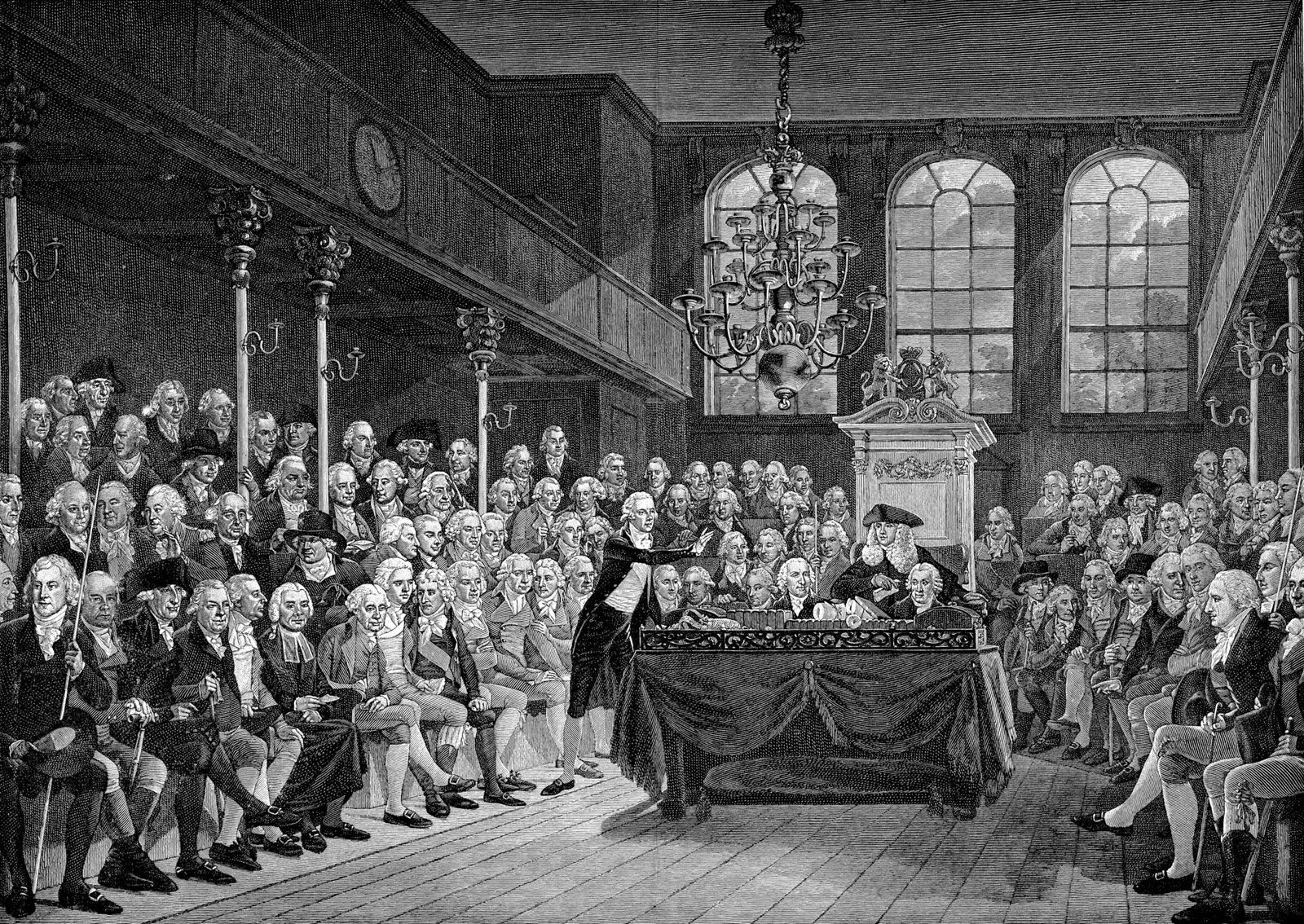
British statesman and Prime Minister, William Pitt the Younger, once stated in a speech in the House of Commons in 1783 that “Necessity is the plea for every infringement of human freedom. It is the argument of tyrants; it is the creed of slaves.”
House of Commons, 1783, William Pitt the Younger
Mr. Pitt’s observation is an apt platform from which to analyze the world we live in today. No matter where on the planet you live, you have been through some combination of nearly three years of lockdowns, church and business closures, mass surveillance, threatened or forced Covid inoculation with an ineffective and dangerous drug therapeutic, and technocratic censorship by social media platforms of anyone who questions the wisdom or beneficence of any of it. There is evidence of substantial state involvement in this censorship. 1https://www.foxnews.com/media/twitter-files-part-9-vast-web-coordination-between-tech-giant-cia-state-department, 2https://twitter.com/mtaibbi/status/1606701397109796866
In Orwellian China, 280 million people were recently locked in their apartments and homes for months, unable to do basic tasks like grocery shopping or banking, and suffering intimidation by armed state police. 3https://www.bbc.com/news/world-asia-china-63310524
Without exception, it was claimed by the powerful that each of the foregoing violations of the God-given liberties of humanity was “necessary” for the sake of the common good.
So let us return to Mr. Pitt’s statement. The first and second part can be characterized as observations about the nature of tyranny and tyrants generally. At a basic level, Mr. Pitt states, tyrants always attempt to justify cruelty and despotism with the excuse that it is “necessary”. This, Pitt states, is the “argument of tyrants”.
The last part of Pitt’s statement refers to the response of human beings to tyrants. There will be tyrants in this wicked world until Jesus returns, which raises the question of how one should respond to tyrants in their various forms, be they tyrants of the church or tyrants of the state. So, what does it mean that necessity “is the creed of slaves”?
It means this: when the individual, or society, accepts the lie from tyrants that their mistreatment and loss of human freedoms is “necessary”, their acceptance is an act of self-enslavement. Or, put another way, it is the essence of slavery to believe the lie that tyranny is justified under any circumstances.
In 1898, A. T. Jones published an article in the American Sentinel entitled, Natural Rights and the Common Good.
There is no more fallacious theory extant than that which is embodied in the common idea that natural rights must be limited by law in order to promote the “common good.” Natural rights are the rights given to man by the Creator. They are neither more nor less than what the Creator made them. To say that they need to be clipped and pruned down … is to reflect upon the wisdom of the Creator.
Rights were given to the individual for his good. Among man’s “inalienable rights” the Declaration of Independence enumerates “life, liberty, and the pursuit of happiness.” The more of these things an individual has, the better off he is, and the more of prosperity does he enjoy. And the more individuals there are of this kind in the community, the more prosperity and happiness is there in the community.
What, on the other hand, is the “common good”? It is a very indefinite term. Each person defines it to suit himself. Government define it to suit themselves. Over in Russia it is declared to be for the “common good” that the little children of heretical parents should be taken from their homes and sent away to be brought up in the orthodox “faith.” In Peru, until recently, it was considered to be for the common good that no Protestant marriage ceremonies should be recognized as valid by the state. In Spain it was for the common good that Protestants should not be allowed to worship in church buildings. The list of instances in which personal rights have been invaded under the plea of the “common good,” might be extended indefinitely. How are these things decided to be for the common good? Oh, it is by the decision of the majority, at least of those in power. And this is the way the question is always decided; this is the way it is proposed to decide the question to day, and the only way in which civil government can consider it, in this country at least. A natural right, therefore, as limited by the “common good,” is simply such a privilege as the majority may see fit to grant. And this would take the matter out of the hands of the Creator entirely. It would leave no force to the term “natural” right at all. For what a person is allowed to have by the majority, cannot be his by nature—by birth. [emphasis added]
American Sentinel April 21, 1898, page 243
Jones sets the matter out faithfully and clearly. The gift of inalienable rights is to ensure that those rights bestowed by the Creator cannot be alienated (removed) from His children by tyrants. Even, and especially, by tyrants who claim to justify their oppression by claiming the false necessity of the common good.
Nor are these inalienable rights solely the property of Americans. No, they are the property of every child of the Creator. As Abraham Lincoln stated,
Our reliance is in the love of liberty which God has planted in us. Our defense is in the spirit which prizes liberty as the heritage of all men, in all lands everywhere. Destroy this spirit, and you have planted the seeds of despotism at your own doors. Familiarize yourself with the chains of bondage, and you prepare your own limbs to wear them.
Abraham Lincoln, in a speech at Edwardsville, Ill, September 13, 1858
Today, the western world is preparing to wear these chains. A growing chorus of voices is calling for the subordination of the concept of individual rights and freedoms for the sake of what is falsely claimed to be the common good. On issues of climate, social justice, public health, economics and family cohesion, the argument is that centralized authority must control the lives of humanity despite the objections of individuals or minorities with their trifling quibbles of conscience and “rights”. Make no mistake, this is the argument of tyrants.
Let us consider recent examples of the use of this false justification.
Example 2. Pope Francis says that global problems, such as climate change and protecting family rest time, need a supranational authority to enforce rules for the common good. According to a 2022 article in the Times of Malta, the “common good … entails devolving authority upwards to international bodies to defend family and individual rights…Human rights cannot be advanced to support claims to individual demands that are morally inappropriate.”
“Supranational authority” is simply another term for a centralized global authority which exists beyond the democratic and constitutional safeguards which exist nationally to protect representative government, national sovereignty and individual rights. The papacy for centuries has opposed strong concepts of nationalism for this reason. The reader will note the Times of Malta’s circular reasoning regarding individual rights and centralized moral authority: 1. human rights cannot be asserted if it is determined that individual demands are “morally inappropriate”; 2. the same centralized international body which determines what is in the common good also has the power to determine whether objections to its initiatives are “morally inappropriate”. Such rationale neatly deprives individuals both of rights, and the ability to assert them, which is the essence of totalitarianism and a re-establishment of the absolute power of the papacy during the Middle Ages.
Example 3. In his commentary for World Youth Day on January 1, 2023, Pope Francis stated the following:
We can no longer think exclusively of carving out space for our personal or national interests; instead, we must think in terms of the common good, recognizing that we belong to a greater community, and opening our minds and hearts to universal human fraternity. We cannot continue to focus simply on preserving ourselves; rather, the time has come for all of us to endeavour to heal our society and our planet, to lay the foundations for a more just and peaceful world, and to commit ourselves seriously to pursuing a good that is truly common.”
Example 4. A number of “Catholic integralists” are openly urging U.S. courts to reject the originalism method of constitutional interpretation in favor of a new concept known as, unsurprisingly, “common good constitutionalism”. “Originalism” is that doctrine which requires courts to interpret the Constitution as it was originally intended, with, for example, its paramount protections for the individual rights of religion, speech, the press, and to petition the government for a redress of grievances. “Common good constitutionalism”, on the other hand, is a cloak for the subordination of these individual rights in favor of papal social moralism.
Proponents of these ideas would give global moral authority to the papacy, just as the Pope has now been made the moral authority of many companies, including Visa and Mastercard, in the so-called Council for Inclusive Capitalism.
Conclusion
Obviously, if it is accepted that the common good necessitates and excuses authoritarianism, it follows that those deemed to be non-compliant should and will be punished because, it is argued, all non-conformists endanger the common good.
History warns that there is no regard for individual rights in such a system.
But this is not Christ’s way, and this is not Christ’s system of government, for “the Lord is that Spirit: and where the Spirit of the Lord is, there is liberty” – 2 Corinthians 3:17. Christ searches and calls for each one, but compels none. He says, “Come, let us reason together” – Isaiah 1:18, and, “Let him who is athirst com. And whosoever will, let him take of the water of life freely” – Revelation 22:17. Christ provides the water of life for all, but He compels none to drink.
As Thomas Jefferson maintained in the Virginia Act for Establishing Religious Freedom:
Almighty God hath created the mind free; … all attempts to influence it by temporal punishments or burdens, or by civil incapacitations, tend only to beget habits of hypocrisy and meanness, and are a departure from the plan of the holy Author of our religion, who being Lord both of body and mind, yet chose not to propagate it by coercions on either, as was in His almighty power to do.
Act for Establishing Religious Freedom, January 16, 1786
In contrast to the principles of the religion of Christ, Revelation 13’s end time scenario is built on the argument by civil and religious powers that it is necessary to prevent buying and selling for those who have refused the mark of the authority of the first beast. There is no doubt that this end time mandate will also be couched in the false argument of the common good, and that it will cruelly persecute dissenters. There will be no exceptions allowed.
And it will still be the argument of tyrants, and the creed of slaves.
Without exception, it was claimed by the powerful that each of the foregoing violations of the God-given liberties of humanity was “necessary” for the sake of the common good.