Email your objection to [email protected] before midnight as Sunday, July 12 turns into Monday, July 13.
Deadline shown in Pacific time.
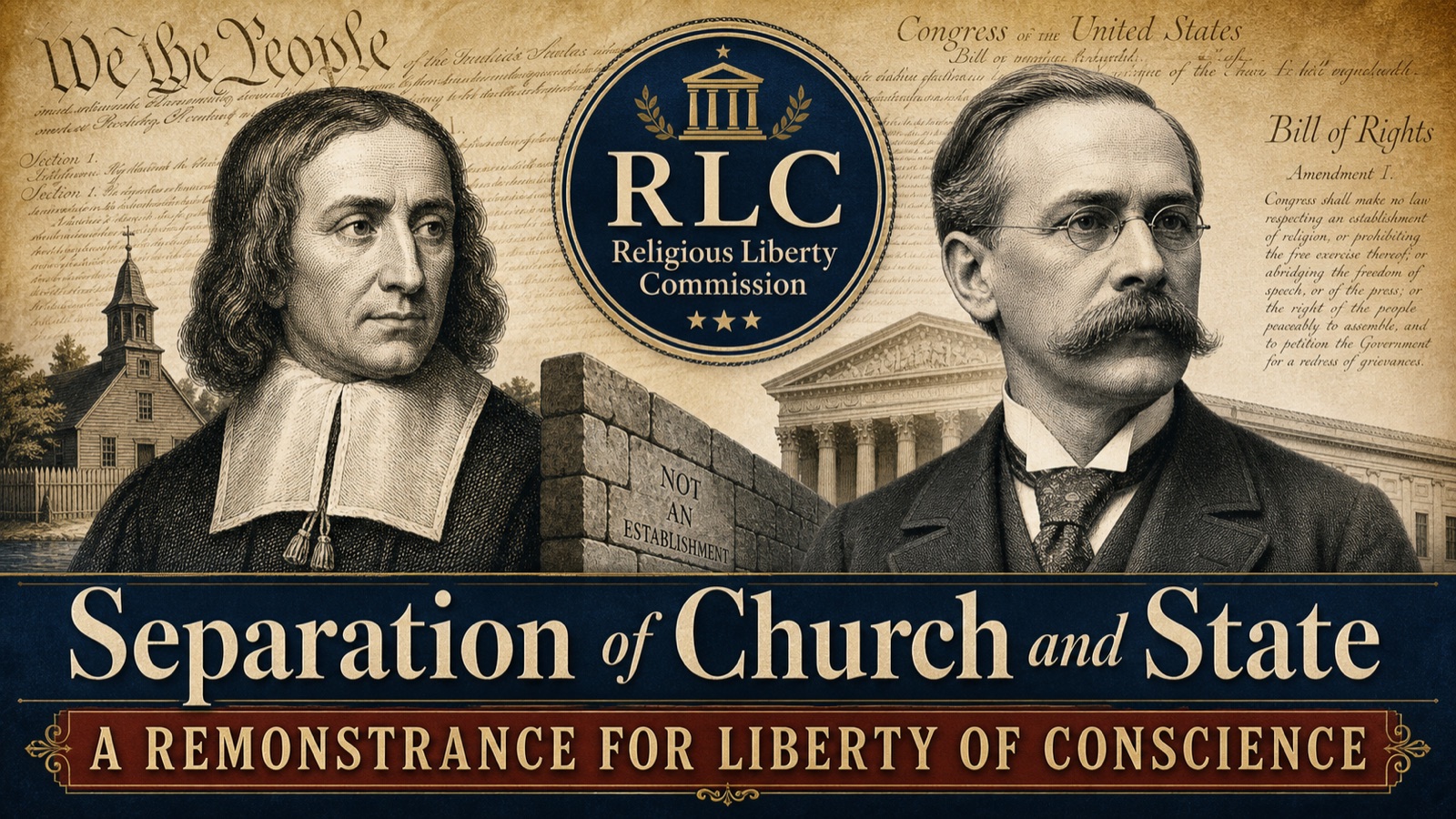
Two days after the Fourth of July, the question before America is not merely whether religion should be honored in public life. It should be. The question is whether religious liberty is best protected by joining church and state together, or by keeping civil power from possessing the conscience.
The Religious Liberty Commission’s report is right to identify a real danger. Religious citizens should not be told to leave their convictions at home when they enter a school, a workplace, a hospital, or the public square. Secularism is not neutral when it becomes an ideology that silences religious conviction. A government that excludes faith from public life is not protecting freedom.
But the Commission’s proposed remedy risks exchanging one form of coercion for another. If secular power should not dominate religion, religious power should not be invited to use the machinery, money, and symbols of the state.
The matter is plain: the Commission’s draft report weakens the separation of church and state, and any union of church and state finally leads to false worship and oppression. The wall of separation was not a secular invention imposed upon religion. It was built by people of faith to protect faith. Roger Williams, dissenting Baptists, Madison, Jefferson, and the long American struggle for disestablishment all testify that religion flourishes most safely when church and state cannot possess one another.
A. T. Jones made the same argument in his 1898 address, What is Patriotism in the United States? Jones defined the patriot as “any defender of liberty, civil or religious.” For him, patriotism in America meant allegiance to the principles that keep religion outside the control of government. This was not because religion is unimportant, but because it is too sacred to be governed by civil power.
Jones argued that government receives its just powers from the consent of the governed, while religion concerns a person’s duty to the Creator. No government can answer to God for an individual soul. Therefore, no government has rightful authority to define, fund, prefer, or direct religion.
That distinction matters now. The Commission objects that the phrase “separation of church and state” has sometimes been misused to drive faith from public life. That misuse should be corrected. But the answer is not to discard the wall. The better distinction is this: there must be no wall between a religious citizen and public participation, but there must remain a wall between ecclesiastical power and civil power.
That wall protects the believer. It protects the unbeliever. It protects the minority church. And it protects the church that refuses to sell its witness for public favor.
This is why the report’s support for expanded public funding of religious organizations and religious education is so troubling. Public money brings public control. Once government funds religious work, government must decide which religious work qualifies, which doctrines may be supported, what counts as education, and which religious conditions are acceptable. The state is then drawn into the very role it should never occupy: judge of religious truth and usefulness.
Jones warned against public money being paid to churches or religious institutions under any pretext. Such support may appear friendly to religion at first, but it makes religious work dependent on political favor. A church that lives by state patronage will eventually be tempted to adjust its witness to keep that patronage.
The same danger appears in government religious displays and Sunday-law reasoning. When the state borrows religious language, it must choose among religious interpretations. Which numbering of the Ten Commandments? Which Sabbath? Which tradition’s public theology? A government that posts or enforces religious symbols may claim to honor faith, but in practice it begins to settle religious questions that belong to conscience and to the churches themselves.
The Commission should also reconsider its recommendation regarding the Johnson Amendment. Churches must be free to preach morality, criticize injustice, defend life, plead for mercy, and speak to the great questions of the day. But converting tax-exempt churches into vehicles for partisan endorsements would bring political money, campaign pressure, and factional discipline into the sanctuary.
The church does not need permission to become a campaign arm. It needs freedom to remain a moral and spiritual witness.
The Commission has identified a real danger: a secularism that would crowd religion out of public life. But the American answer is not an alliance of church and state. Tocqueville observed that religion in America gained its peaceful ascendancy because Americans credited it to the complete separation of church and state. Lyman Beecher, who once feared Connecticut’s disestablishment, later called it the best thing that happened to the churches because it threw them upon their own resources and upon God.
Two days after Independence Day, this is the patriotic question: will America protect religion by keeping it free, or will it try to honor religion by placing it under political management?
A. T. Jones would have answered that true patriotism defends religious liberty by keeping the civil power out of religion. That remains the safer answer. That remains the American answer.
The Commission should revise its historical account and withdraw or substantially modify recommendations that would diminish the separation of church and state, expand public funding of religious activity, support government religious displays, or repeal the Johnson Amendment. Religious liberty is not protected by giving government more religious authority. It is protected by defending liberty of conscience for all. If you share these concerns, add your name to the Freedom Sentinel remonstrance petition and email your objection to the Commission at [email protected] before the public comment window closes. Let the record show that Americans who cherish faith also cherish the wall that keeps faith free.
What the Commission proposes to send to President Trump
In Appendix B, the report identifies “12 Key Recommendations” and then expands them into detailed recommendations. Among the proposals most relevant to church-state separation are:
- Instruct the Department of Justice to issue guidance clarifying the “proper understanding” of the Establishment Clause and separation of church and state. Draft report, p. 200
- Create a DOJ Religious Liberty Task Force and establish Conscience and Religious Freedom Divisions across the federal government. Draft report, pp. 201, 208-210
- Expand partnerships, grants, funds, and contracts for faith-based institutions on an equal basis with secular groups. Draft report, pp. 203, 214
- Repeal the Johnson Amendment; until then, issue Treasury guidance narrowing it and support DOJ litigation challenging it. Draft report, pp. 201, 220
- Promote universal school choice and challenge restrictions that prevent school-choice funds from being used at religious schools. Draft report, pp. 214, 219
- Support religious expression in public schools, including religious clubs, religious materials, release-time religious instruction, student-led prayer, voluntary prayer/chaplain programs, and litigation supporting Ten Commandments and world-religion posters. Draft report, pp. 215-216
- Continue official recognition of America’s religious heritage through presidential proclamations, calls to prayer and fasting, national religious memorials, and restored religious displays in military and VA settings. Draft report, p. 204
- Restore or compensate service members affected by COVID-19 vaccine religious objections and pursue litigation over denied vaccine religious exemptions. Draft report, pp. 202, 222
Check out Sources
- 1
- 2