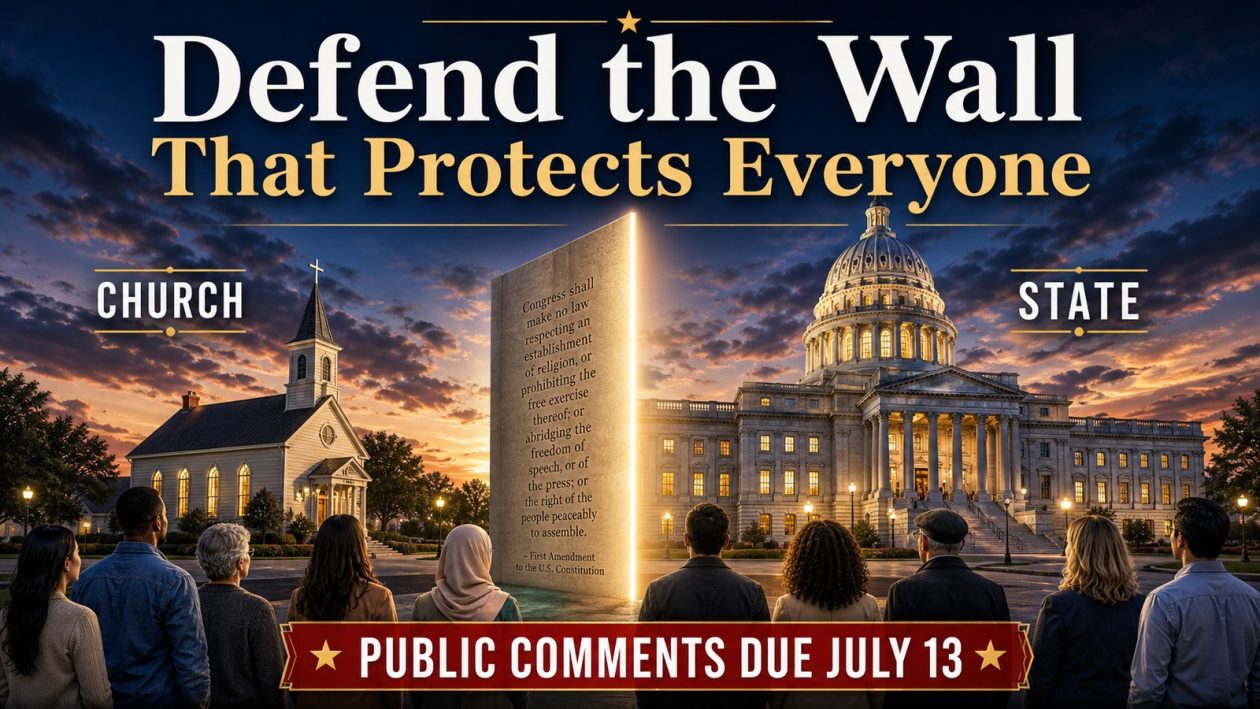
Email your public comment to [email protected] before midnight Eastern Time as Sunday, July 12 turns into Monday, July 13, 2026.
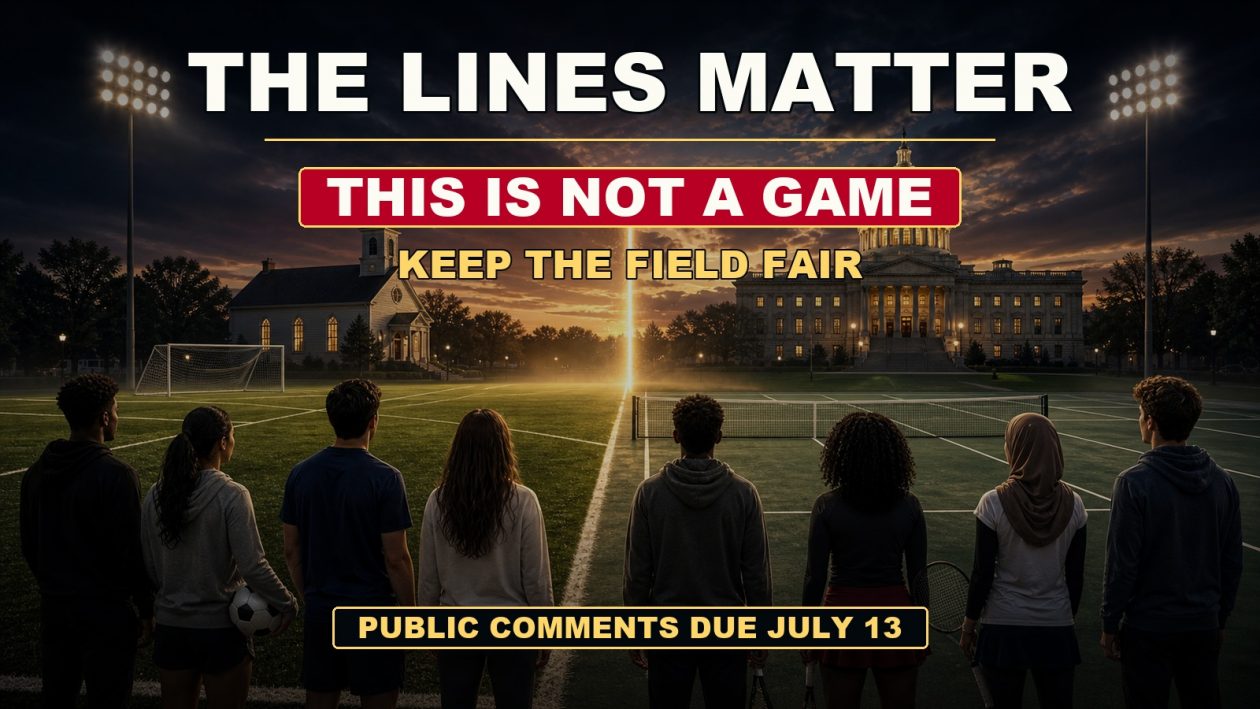
This summer, millions of people are watching the World Cup across North America and Wimbledon in England. We understand instantly why rules matter. The lines matter. The referee matters. The official cannot quietly play for one side and still call it a fair match.
Religious liberty works the same way.
When government takes sides in religion, it stops being the referee and steps onto the field. That may feel harmless when the government favors your side. But the same power that favors one faith today can burden another tomorrow.
This is not a game. The stakes are conscience, worship, minority rights, and the freedom of every person to answer to God without Caesar standing in between.
Take ten minutes
Add your voice before July 13.
You do not need to sound like a politician. Choose one point, write personally, and ask the Commission to protect free exercise without weakening church-state separation.
In sports, boundary lines are not decoration. They tell everyone where the game is fair, where the official must be neutral, and when power has crossed into the wrong place.
Liberty has lines too.
If we care about our neighbors, we do not ask government to pressure their conscience. If we care about our faith, we do not hand it to politicians to manage. If we care about liberty, we defend it when it protects people who are different from us.
That is why church-state separation is not anti-religious. It is one of the ways a free society keeps the field fair. It keeps the state from choosing winners and losers in matters of conscience.
The Rule Is Simple
The game only works when the referee is neutral.
The republic only works when civil government stays civil.
Government may protect people from violence, coercion, discrimination, and fraud. It may defend the right of every person to worship freely. But it may not command worship, sponsor religious observance, interpret sacred law, or use public power to promote one faith's practices over another's.
That line protects everyone: the Christian, the Jew, the Muslim, the Buddhist, the Hindu, the atheist, the student who is still searching, and the minority believer whose convictions are not popular.
Why This Matters Right Now
Public comments on the Religious Liberty Commission draft report are due Monday, July 13, 2026. That deadline comes immediately after Wimbledon ends on July 12 and while the World Cup is being played across North America, including the United States.
The Commission needs to hear from younger voices, students, young professionals, church members, and first-time public commenters who understand that religious liberty is not a culture-war trophy. It is a shield for every conscience.
Do not weaken the Establishment Clause.
Do not make public schools instruments for government-sponsored religion.
Do not use the state to interpret or promote sacred law.
Do strengthen free exercise, conscience protections, and religious accommodation for everyone.
Free exercise and non-establishment are not enemies. They are one shield.
A. T. Jones Saw the Danger
In 1888, A. T. Jones testified before the United States Senate against national Sunday legislation. His point was direct: civil government is civil. It has no rightful authority over religious observance.
Jones argued from the words of Jesus: "Render therefore unto Caesar the things which are Caesar's; and unto God the things that are God's." That is not a slogan. It is a boundary.
Some things belong to Caesar: public order, civil rights, protection from harm, equal justice under law.
Some things do not belong to Caesar: worship, conscience, sacred time, duties owed to God.
When government crosses that line, it may begin with good intentions. But history shows where it leads. The power to favor religion becomes the power to control religion.
What You Can Do in Ten Minutes
You do not need to write a legal brief. You do not need to sound like a politician. You need to speak clearly, respectfully, and personally.
Choose one point that matters to you.
Write three to six short paragraphs.
Add one personal sentence about why religious liberty matters to you.
Ask the Commission to protect free exercise without weakening church-state separation.
I am writing as a young citizen who believes religious liberty is protected best when government does not take sides in matters of worship and conscience.
The state should protect every person's right to believe, worship, rest, speak, and live according to conscience. But civil government should not sponsor religious observance, interpret sacred law, or use public schools to promote religion.
Free exercise and church-state separation belong together. A government with no authority to sponsor religion has no authority to suppress it. That protects people of every faith and people of no faith.
I urge the Commission to strengthen religious accommodation and conscience protections while preserving the Establishment Clause and the separation of church and state.
Email your public comment to [email protected] before midnight Eastern Time as Sunday, July 12 turns into Monday, July 13, 2026.
Write your public comment
Use the model letters, but add your own voice.
Choose one theme, personalize it with one or two sentences, and email your comment by Monday, July 13, 2026. Individual comments carry more weight than identical copied letters.
Choose one approach: two jurisdictions, the founders' design, the warning of history, the Adventist testimony, the purity of religion, individual rights, Ten Commandments displays, or a balanced commend-and-caution letter.
Personalize it: add your city and state, faith background, Sabbath accommodation experience, concern for minorities, or family history with religious liberty.
Keep it respectful: firm on principle, courteous in tone, and focused on constitutional and religious-liberty concerns.
To Democratic mayors, governors, attorneys general, legislators, and civic leaders: the Religious Liberty Commission's draft report deserves a clear response from officials who believe in pluralism, civil rights, minority protection, and constitutional government.
The public comment window closes Monday, July 13, 2026. Comments may be emailed to [email protected]. This is a moment for state and local leaders to say plainly that religious liberty is not protected by giving civil government more religious authority. It is protected by keeping government from becoming the patron, manager, referee, or enforcer of religion.
Action requested: Democratic officials should submit public comments before the July 13 deadline, issue public statements defending church-state separation, and oppose state or local measures that convert religious doctrine into civil law.
This Is Not an Anti-Religion Appeal
Religious citizens should not be driven from public life. A teacher, nurse, student, business owner, public employee, or elected official does not surrender conscience by entering the public square. Religious expression, worship, and moral conviction deserve robust protection.
But protecting religious people is not the same thing as inviting government to fund, prefer, display, or enforce religion. A free society can protect the religious speech of citizens while still refusing to make civil power the instrument of a religious program. There should be no wall between a religious citizen and public participation. There must remain a wall between ecclesiastical power and civil power.
What the Report Moves Toward
The Commission's report uses the language of religious liberty, but several of its recommendations would move the country toward a more official partnership between government and religion. Among the proposals most relevant to state and local officials are these:
DOJ guidance redefining the Establishment Clause and the meaning of separation of church and state.
New federal religious-liberty offices, divisions, task forces, reporting portals, investigations, and enforcement strategies.
Expanded federal partnerships, grants, funds, and contracts for faith-based institutions.
Universal school choice and litigation to ensure public funds may flow to religious schools.
Federal support for religious expression in public schools, voluntary prayer or chaplain programs, release-time religious instruction, and Ten Commandments or world-religion posters.
Repeal of the Johnson Amendment, which would pull churches and religious nonprofits closer to partisan campaign machinery.
Officials who care about civil rights should read those recommendations carefully. The danger is not simply that religion will have a voice in public life. Religious citizens already have that right. The danger is that government will begin to decide which religious activities deserve public support, which religious symbols represent the public, and which religious voices should be amplified by public authority.
Why Democratic Officials Should Care
Church-state separation is not a secularist weapon against religion. Historically, it has been one of the chief safeguards for minority faiths, religious dissenters, nonbelievers, and churches that refuse political control. It protects Baptists from Congregational establishments, Quakers from Puritan punishment, Jews and Adventists from Sunday-law majorities, Muslims from Christian preference, and Christians themselves from state-managed religion.
Democratic officials often speak the language of pluralism and inclusion. This is where that language must become policy. A government that favors religion today can favor a different religion tomorrow. A government that funds religious work today can regulate it tomorrow. A government that posts religious symbols today can choose among competing religious interpretations tomorrow. The state is not competent to judge religious truth, and it should not be asked to do so.
The Historical Warning
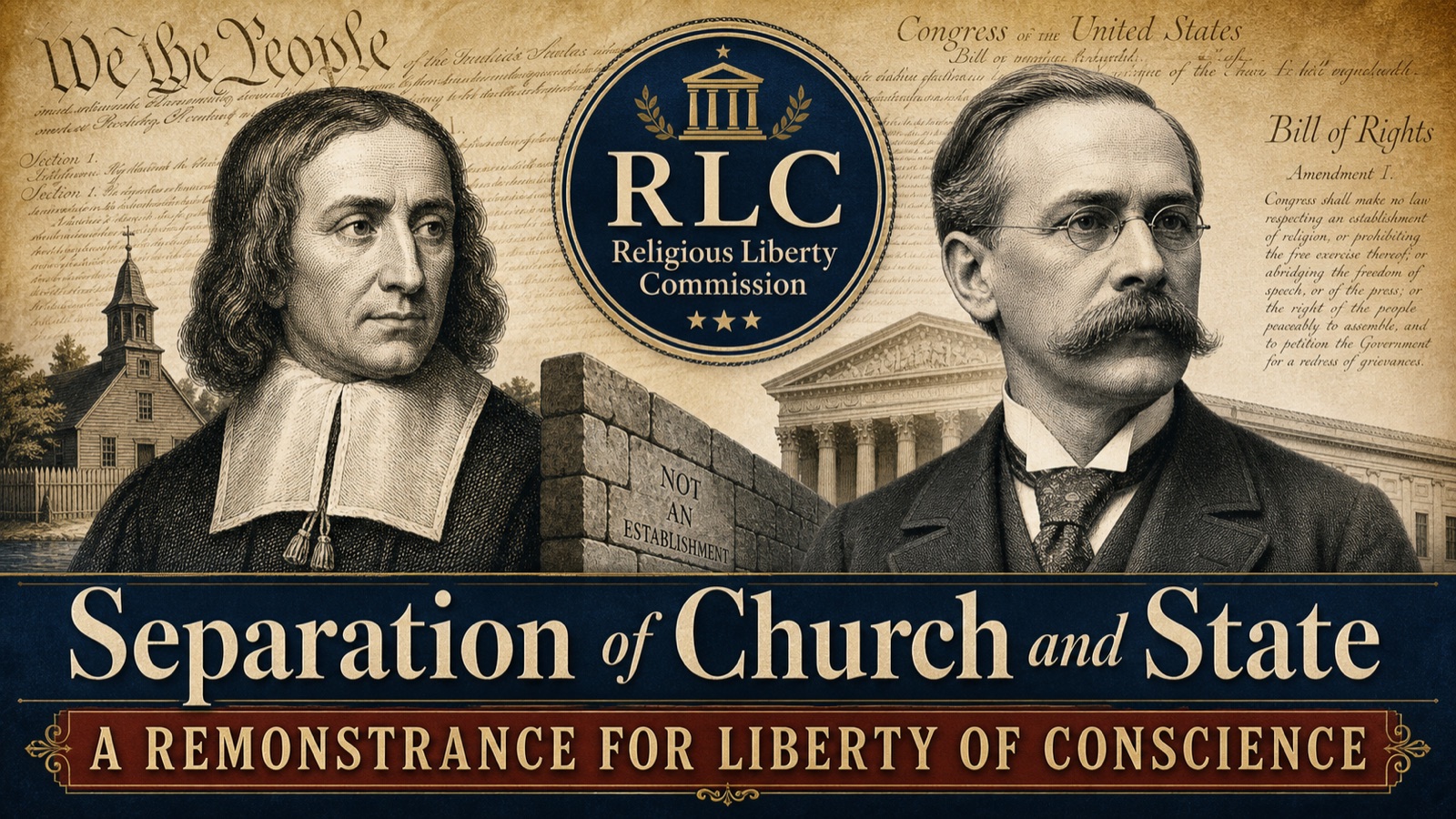
America has already tested church-state union. The result was not liberty. Established colonial churches brought religious taxes, religious tests, exclusion from public privileges, and penalties for dissent. Jefferson's phrase, a "wall of separation between Church and State," was not designed to exile faith from public life. It was meant to protect conscience from civil control. Madison's Memorial and Remonstrance warned against making the civil magistrate a judge of religious truth or using religion as an engine of civil policy.
Sunday laws provide a special warning for state and local leaders. They have often been defended as moral order, social rest, family protection, or public welfare. Yet in practice, religiously shaped rest laws have punished minorities whose Sabbath convictions differed from the majority. In Arkansas in 1885, Seventh-day Adventists were prosecuted for ordinary Sunday labor. J. W. Scoles was prosecuted after working to finish painting a church building. Allen Meeks was pursued for planting potatoes on Sunday. The point is not antiquarian curiosity. It is that civil law can become oppressive when it adopts the calendar and conscience of a religious majority.
The Line Officials Should Draw
Democratic officials should draw a bright constitutional line: protect the free exercise of every citizen, but do not establish, fund, prefer, or enforce religion through civil power.
Defend religious speech by private citizens, students, employees, and public officials speaking in their personal capacity.
Oppose public funding arrangements that make the state a judge of religious eligibility, mission, doctrine, or usefulness.
Reject religious displays or programs that make government appear to speak for one faith tradition.
Oppose Sunday-rest or Sabbath legislation, even when repackaged as worker, family, or climate policy, if it burdens ordinary labor, travel, commerce, or Sabbath-keeping minorities.
Defend churches from government censorship without turning churches into partisan campaign committees.
Suggested Public Comment
Officials may adapt the following language and send it to [email protected] before the July 13 deadline:
I urge the Religious Liberty Commission to revise any recommendations that diminish the separation of church and state, expand government funding or management of religious activity, encourage government religious displays, or invite partisan campaign machinery into houses of worship. Religious liberty requires both free exercise and non-establishment. Government should protect the rights of religious citizens without becoming the patron, promoter, or referee of religion. The constitutional wall of separation protects believers, nonbelievers, minority faiths, and the public peace.
This is not a left-versus-right question at its root. It is a constitutional question. Will America protect religion by keeping it free, or will it try to honor religion by placing it under political management? Democratic officials should answer now, clearly and publicly: liberty of conscience is for everyone, and the wall that protects it should stand.
Email your objection to [email protected] before midnight as Sunday, July 12 turns into Monday, July 13.
Deadline shown in Pacific time.
Two days after the Fourth of July, the question before America is not merely whether religion should be honored in public life. It should be. The question is whether religious liberty is best protected by joining church and state together, or by keeping civil power from possessing the conscience.
The Religious Liberty Commission’s report is right to identify a real danger. Religious citizens should not be told to leave their convictions at home when they enter a school, a workplace, a hospital, or the public square. Secularism is not neutral when it becomes an ideology that silences religious conviction. A government that excludes faith from public life is not protecting freedom.
But the Commission’s proposed remedy risks exchanging one form of coercion for another. If secular power should not dominate religion, religious power should not be invited to use the machinery, money, and symbols of the state.
The matter is plain: the Commission’s draft report weakens the separation of church and state, and any union of church and state finally leads to false worship and oppression. The wall of separation was not a secular invention imposed upon religion. It was built by people of faith to protect faith. Roger Williams, dissenting Baptists, Madison, Jefferson, and the long American struggle for disestablishment all testify that religion flourishes most safely when church and state cannot possess one another.
A. T. Jones made the same argument in his 1898 address, What is Patriotism in the United States? Jones defined the patriot as “any defender of liberty, civil or religious.” For him, patriotism in America meant allegiance to the principles that keep religion outside the control of government. This was not because religion is unimportant, but because it is too sacred to be governed by civil power.
Jones argued that government receives its just powers from the consent of the governed, while religion concerns a person’s duty to the Creator. No government can answer to God for an individual soul. Therefore, no government has rightful authority to define, fund, prefer, or direct religion.
That distinction matters now. The Commission objects that the phrase “separation of church and state” has sometimes been misused to drive faith from public life. That misuse should be corrected. But the answer is not to discard the wall. The better distinction is this: there must be no wall between a religious citizen and public participation, but there must remain a wall between ecclesiastical power and civil power.
That wall protects the believer. It protects the unbeliever. It protects the minority church. And it protects the church that refuses to sell its witness for public favor.
This is why the report’s support for expanded public funding of religious organizations and religious education is so troubling. Public money brings public control. Once government funds religious work, government must decide which religious work qualifies, which doctrines may be supported, what counts as education, and which religious conditions are acceptable. The state is then drawn into the very role it should never occupy: judge of religious truth and usefulness.
Jones warned against public money being paid to churches or religious institutions under any pretext. Such support may appear friendly to religion at first, but it makes religious work dependent on political favor. A church that lives by state patronage will eventually be tempted to adjust its witness to keep that patronage.
The same danger appears in government religious displays and Sunday-law reasoning. When the state borrows religious language, it must choose among religious interpretations. Which numbering of the Ten Commandments? Which Sabbath? Which tradition’s public theology? A government that posts or enforces religious symbols may claim to honor faith, but in practice it begins to settle religious questions that belong to conscience and to the churches themselves.
The Commission should also reconsider its recommendation regarding the Johnson Amendment. Churches must be free to preach morality, criticize injustice, defend life, plead for mercy, and speak to the great questions of the day. But converting tax-exempt churches into vehicles for partisan endorsements would bring political money, campaign pressure, and factional discipline into the sanctuary.
The church does not need permission to become a campaign arm. It needs freedom to remain a moral and spiritual witness.
The Commission has identified a real danger: a secularism that would crowd religion out of public life. But the American answer is not an alliance of church and state. Tocqueville observed that religion in America gained its peaceful ascendancy because Americans credited it to the complete separation of church and state. Lyman Beecher, who once feared Connecticut’s disestablishment, later called it the best thing that happened to the churches because it threw them upon their own resources and upon God.
Two days after Independence Day, this is the patriotic question: will America protect religion by keeping it free, or will it try to honor religion by placing it under political management?
A. T. Jones would have answered that true patriotism defends religious liberty by keeping the civil power out of religion. That remains the safer answer. That remains the American answer.
The Commission should revise its historical account and withdraw or substantially modify recommendations that would diminish the separation of church and state, expand public funding of religious activity, support government religious displays, or repeal the Johnson Amendment. Religious liberty is not protected by giving government more religious authority. It is protected by defending liberty of conscience for all. If you share these concerns, add your name to the Freedom Sentinel remonstrance petition and email your objection to the Commission at [email protected] before the public comment window closes. Let the record show that Americans who cherish faith also cherish the wall that keeps faith free.
What the Commission proposes to send to President Trump
In Appendix B, the report identifies “12 Key Recommendations” and then expands them into detailed recommendations. Among the proposals most relevant to church-state separation are:
Instruct the Department of Justice to issue guidance clarifying the “proper understanding” of the Establishment Clause and separation of church and state. Draft report, p. 200
Create a DOJ Religious Liberty Task Force and establish Conscience and Religious Freedom Divisions across the federal government. Draft report, pp. 201, 208-210
Expand partnerships, grants, funds, and contracts for faith-based institutions on an equal basis with secular groups. Draft report, pp. 203, 214
Repeal the Johnson Amendment; until then, issue Treasury guidance narrowing it and support DOJ litigation challenging it. Draft report, pp. 201, 220
Promote universal school choice and challenge restrictions that prevent school-choice funds from being used at religious schools. Draft report, pp. 214, 219
Support religious expression in public schools, including religious clubs, religious materials, release-time religious instruction, student-led prayer, voluntary prayer/chaplain programs, and litigation supporting Ten Commandments and world-religion posters. Draft report, pp. 215-216
Continue official recognition of America’s religious heritage through presidential proclamations, calls to prayer and fasting, national religious memorials, and restored religious displays in military and VA settings. Draft report, p. 204
Restore or compensate service members affected by COVID-19 vaccine religious objections and pursue litigation over denied vaccine religious exemptions. Draft report, pp. 202, 222
Modern science holds an increasingly tight grip on all of humanity in the wake of a global crisis. The scientific response to COVID-19 and the development and implementation of its vaccine is now testing the next frontier— the human will, man’s conscience. With the soon-promised vaccine, our dependence on science raises questions on the ethical implications that arise from this proposed solution to end the world’s current crisis. With all of these events unfolding before our eyes, we must ask ourselves what we are willing to surrender in the name of science.
In general physiology college courses, we commonly learn that DNA is the blueprint of all life. We learn of the fine-tuned mechanisms involved in the sustenance of life, best illustrated by the coordination of different instruments in an extensive and complex orchestra. We see how tRNA (transfer ribonucleic acid) and mRNA (messenger ribonucleic acid) dance together in a joyously choreographed swirl in the ribosomal dance hall to produce proteins, which provide the structure, function, and regulation of the body. For me, the knowledge of this dynamic pirouetting team turned an ordinary physiology class into a deeper appreciation of my Creator who wrote the script, molded the three-dimensional design with His own hands, and then breathed into that inanimate form the breath of life. Even more astounding than this, He gave us liberty of conscience with a mind that could grasp the operations of His creation and a will to choose to cooperate with Him as He continues to sustain this life that He created.
As I monitor the developments occurring in the scientific field today and study the solutions put forward to address COVID-19, I am troubled by the way science is violating its own safeguards as well as the laws of design instilled by God. One of the foundational principles of science is that it is based on that which is verifiable and measurable. One of the places that we see inconsistency is in the testing of the virus, which is utilized as a determinant of eligibility to participate in society, despite the mixed criteria that surround its implementation.
Additionally, modern science is violating the law of God by using processes that He has put together and combining elements from life sources that should not be merged, thus thinking itself wiser than God. This is the case in the DNA and RNA-based vaccines currently being proposed as the only way out of this world-wide dilemma.
I am troubled by the way science is violating its own safeguards as well as the laws of design instilled by God.
The options on the table at this point for vaccines for the novel coronavirus are problematic on many levels. One concern is the actual engineering employed. The Moderna and Pfizer editions of the vaccines are delivered via mRNA housed in a lipid capsule that eases its transfer through the cell membrane. Once in the cell, it employs ribosomes to produce antibodies to cap off the ‘spike proteins’ of the virus in the circulatory system rendering it unable to infect cells. The question arises as to the origin and composition of not only the mRNA and its lipid envelope, but also that of the strands of genetic information and their effect on the cytoplasm in particular. A study done by Pardi et. al. (2018) lists some of the possible side effects that needed to be explored before the vaccine’s efficacy can be established:
Potential safety concerns that are likely to be evaluated in future preclinical and clinical studies include local and systemic inflammation, the biodistribution and persistence of expressed immunogen, stimulation of auto-reactive antibodies and potential toxic effects of any non-native nucleotides and delivery system components.
1 Pardi N, Hogan MJ, Porter FW, Weissman D. mRNA vaccines – a new era in vaccinology. Nat Rev Drug Discov. 2018;17(4):261-279. https://pubmed.ncbi.nlm.nih.gov/29326426/
With the current ‘warp speed’ development and corners being cut, many of these concerns remain valid. About one month into the epidemic on March 16, 2020 an article in the New Republic read :
On Monday, Moderna Therapeutics, a Massachusetts-based company, began the first human clinical trials of its vaccine in Seattle, Washington—skipping the typical phase of trials wherein a new vaccine or medication is tested on animals first. A successful vaccine could be a lifesaver for many. But bioethicists are also concerned about the compressed timeline…
Schreiber, M. (2020, March 16). The Risky Race for a Quick Coronavirus Vaccine. Retrieved December 10, 2020
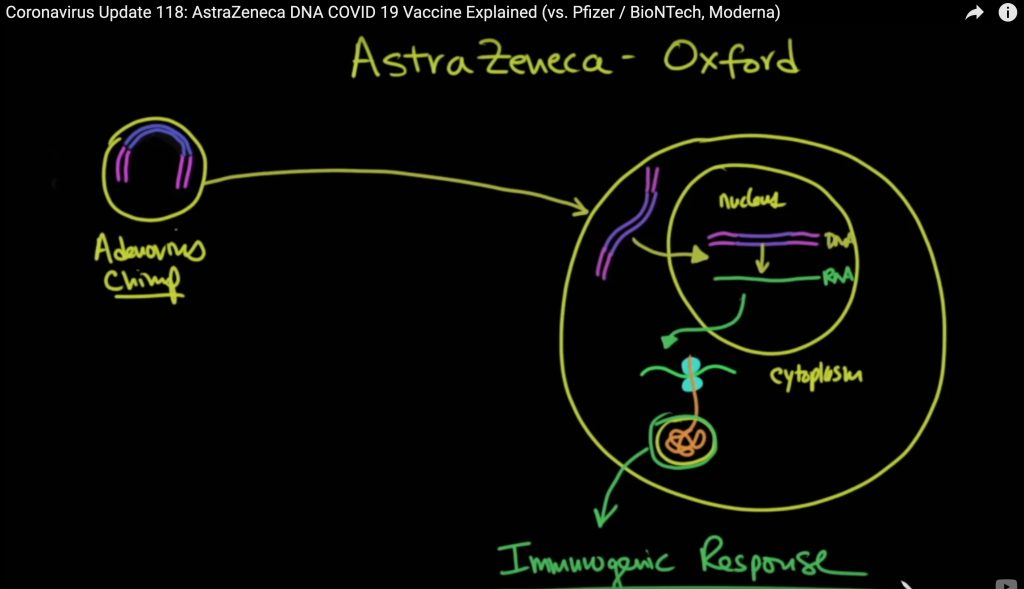
The AstraZeneca version of the Covid vaccine is different, yet some of the safety concerns are even more troublesome since it is engineered from DNA rather than RNA. DNA is resident in the nucleus whereas RNA is predominantly in the cytoplasm. This vaccine is also housed in a lipid layer, but the source of the DNA is a virus taken from the Rotavirus that infects chimpanzees and used in humans because of their low inflammatory impact. The scientists have stripped the DNA of some of its genetic sequences and spliced in portions of the coronavirus features, which will instruct the nucleus to create the requisite mRNA-bearing instructions to produce the spike protein in the ribosomes of the cytoplasm. The spike protein will serve as sentinels surrounding the cell as with the mRNA. The scientists at AstraZeneca assure us that there are no remnants of this foreign DNA left behind in the nucleus following their task. However, not much evidence supports this and we should not forget that science, despite its incredible advances, still only understands the function of about 5% of the human genome.
Whereas the previous vaccines introduced a minuscule part of a disease to trigger the body’s immune response, they weren’t as invasive as this new technology. These new vaccines advance further than before, with both DNA and RNA vaccines entering into the cell. To put it in simple terms, the RNA vaccine enters the cell through the lipid layer and provides the information for the assembly of the spike protein that will protect the cell. The DNA vaccine enters the nucleus where it is transcribed into mRNA, which exits into the cytoplasm and then performs the same process as the RNA vaccine.
This form of vaccination is unlike any other previous vaccine. Whether mRNA or DNA-based vaccines, we face a dilemma concerning their sourcing and also their impact. If the mRNA and lipid layer is of human extract then who is it from?And with the DNA version, we are told that the vaccines utilize a modified chimpanzee virus. Where in man’s engineering record has the successful manipulation of elements of nature not resulted in a questionable or deadly outcome? Decades after the Manhattan Project, where the atom was tampered with, we are still trying to contain the nuclear byproducts. That was the attempt to move electrons to different orbitals; this is manipulating the core mechanisms of life. I see the effects of the atom manipulation each day as I care for people who came into contact with nuclear fallout, all the time thinking they were protected by “best practices” and now suffering because of it. I cannot with good conscience administer man’s next scientific manipulation to their fragile constitutions.
One of our roles as nurses is as the patient’s advocate. A good nurse will relieve the fears of a patient through education. Most doubts and fears about medical procedures and treatments can be overcome through a solid knowledge base and sound reason to explain the realities. It is impossible to do that with this vaccine. Like the safety measures implemented so far, the realities of the development of the COVID-19 vaccine are shrouded in mystery, hidden behind patents, and thus not open for public investigation. The argument of the ‘greater good’ is not sufficient for us to trust these new medical technologies.
Through financial and social pressure we will be forced to surrender our bodies to a man-made defense system that many of us are not convinced of, and others find unethical. An ultimatum to take the COVID-19 vaccine or lose our job, or worse, has no precedent on this scale in a free society. Are we given the option to follow our conscience?
I chose to be a nurse because of the Divine nudging that suggested that my gifts for benefiting others lay in nursing. My compassionate Creator had a tough time convincing me of this, but that is how He works. “Come let us reason together, says the Lord” (Isaiah 1:18). His prompting for me to pursue a career in nursing came through distinct providential circumstances: not only having my school paid for by a gracious aunt but also via a friend urging me in this career notwithstanding my occupational resistance to enter. I had a choice and I made one of my better decisions, career-wise. I have not regretted it for one moment.
Now I am faced with a significant choice again. This time my understanding of science and God’s call to nursing is clashing with a rationalistic science that is at odds with itself, one that threatens the liberty of conscience of healthcare workers, coercing the conscience through financial and social pressure, all for the “greater good”.
For the last twenty-five years, I have been depending on the God that led me into nursing to protect me against occupational hazards like colds and influenza through a robust immune system. I have marveled at these natural built-in defenses and have kept in tune with His laws of health through proper nutrition, exercise, water, sunlight, temperance, fresh air, rest, and trust in Divine power. These laws preserve the functions He has designated to my DNA and I praise Him for giving me life and health. He has proven faithful in His promise to me. I believe David echoed these thoughts as he said:
” I praise You, for I fearfully and wonderfully made. Marvelous are Your works, and I know this very well.”
Psalms 139:14
The question now is whose laws will I subscribe to? God’s natural law written in my DNA or a DNA-loaded vaccine whose contribution to the delicate symphony of life could be discordant and dishonoring to His original intent?
As nurses and doctors, we are approaching a fork in the road. Will we choose to take the well-beaten path that science bids us down, or with conscience clear take the road less traveled? It is only a matter of days before we must decide. Do we have enough time to break out our notes from nursing school to review our knowledge of the cell? What is an mRNA-based vaccine going to do? What will a DNA-based vaccine do? And once informed on the biological and ethical implications, what will we choose? To trust in man or trust in the Creator of man? I urge you, friends, to place your trust in your Creator and Designer who loves you more than life itself and has promised to provide for you. He will take care of you.
1 Pardi N, Hogan MJ, Porter FW, Weissman D. mRNA vaccines – A New Era in Vaccinology. Nat Rev Drug Discov. 2018;17(4):261-279. https://pubmed.ncbi.nlm.nih.gov/293264263