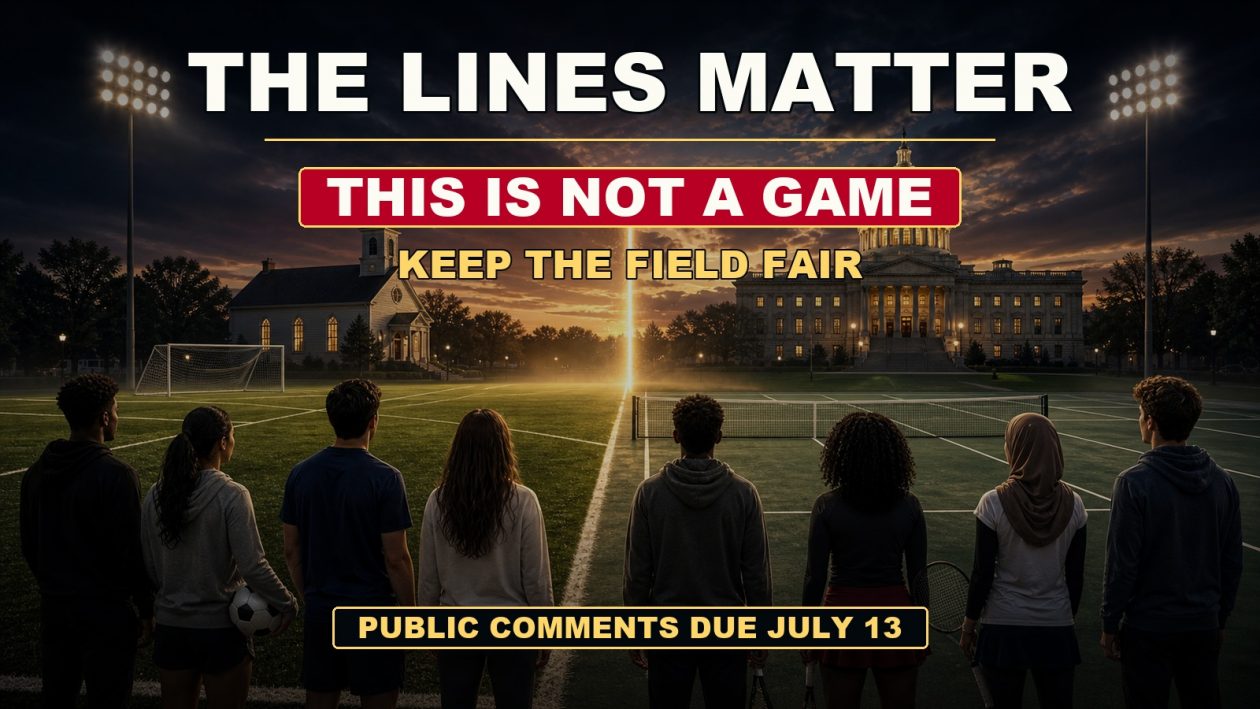
The Lines Matter: This Is Not a Game

This is not a game
Time left to speak up
Days
Hours
Minutes
Seconds

Email your public comment to [email protected] before midnight Eastern Time as Sunday, July 12 turns into Monday, July 13, 2026.

This summer, millions of people are watching the World Cup across North America and Wimbledon in England. We understand instantly why rules matter. The lines matter. The referee matters. The official cannot quietly play for one side and still call it a fair match.

Religious liberty works the same way.

When government takes sides in religion, it stops being the referee and steps onto the field. That may feel harmless when the government favors your side. But the same power that favors one faith today can burden another tomorrow.

This is not a game. The stakes are conscience, worship, minority rights, and the freedom of every person to answer to God without Caesar standing in between.

Take ten minutes

Add your voice before July 13.

You do not need to sound like a politician. Choose one point, write personally, and ask the Commission to protect free exercise without weakening church-state separation.

The Lines Are There for a Reason

In sports, boundary lines are not decoration. They tell everyone where the game is fair, where the official must be neutral, and when power has crossed into the wrong place.

Liberty has lines too.

If we care about our neighbors, we do not ask government to pressure their conscience. If we care about our faith, we do not hand it to politicians to manage. If we care about liberty, we defend it when it protects people who are different from us.

That is why church-state separation is not anti-religious. It is one of the ways a free society keeps the field fair. It keeps the state from choosing winners and losers in matters of conscience.

The Rule Is Simple

The game only works when the referee is neutral.

The republic only works when civil government stays civil.

Government may protect people from violence, coercion, discrimination, and fraud. It may defend the right of every person to worship freely. But it may not command worship, sponsor religious observance, interpret sacred law, or use public power to promote one faith's practices over another's.

That line protects everyone: the Christian, the Jew, the Muslim, the Buddhist, the Hindu, the atheist, the student who is still searching, and the minority believer whose convictions are not popular.

Why This Matters Right Now

Public comments on the Religious Liberty Commission draft report are due Monday, July 13, 2026. That deadline comes immediately after Wimbledon ends on July 12 and while the World Cup is being played across North America, including the United States.

The Commission needs to hear from younger voices, students, young professionals, church members, and first-time public commenters who understand that religious liberty is not a culture-war trophy. It is a shield for every conscience.

  • Do not weaken the Establishment Clause.
  • Do not make public schools instruments for government-sponsored religion.
  • Do not use the state to interpret or promote sacred law.
  • Do strengthen free exercise, conscience protections, and religious accommodation for everyone.

Free exercise and non-establishment are not enemies. They are one shield.

A. T. Jones Saw the Danger

In 1888, A. T. Jones testified before the United States Senate against national Sunday legislation. His point was direct: civil government is civil. It has no rightful authority over religious observance.

Jones argued from the words of Jesus: "Render therefore unto Caesar the things which are Caesar's; and unto God the things that are God's." That is not a slogan. It is a boundary.

Some things belong to Caesar: public order, civil rights, protection from harm, equal justice under law.

Some things do not belong to Caesar: worship, conscience, sacred time, duties owed to God.

When government crosses that line, it may begin with good intentions. But history shows where it leads. The power to favor religion becomes the power to control religion.

What You Can Do in Ten Minutes

You do not need to write a legal brief. You do not need to sound like a politician. You need to speak clearly, respectfully, and personally.

  1. Choose one point that matters to you.
  2. Write three to six short paragraphs.
  3. Add one personal sentence about why religious liberty matters to you.
  4. Ask the Commission to protect free exercise without weakening church-state separation.
  5. Email it before the deadline.

Send your public comment to [email protected].

A Short Comment You Can Adapt

Dear Members of the Religious Liberty Commission,

I am writing as a young citizen who believes religious liberty is protected best when government does not take sides in matters of worship and conscience.

The state should protect every person's right to believe, worship, rest, speak, and live according to conscience. But civil government should not sponsor religious observance, interpret sacred law, or use public schools to promote religion.

Free exercise and church-state separation belong together. A government with no authority to sponsor religion has no authority to suppress it. That protects people of every faith and people of no faith.

I urge the Commission to strengthen religious accommodation and conscience protections while preserving the Establishment Clause and the separation of church and state.

Respectfully,
[Name]
[City, State]

For a fuller argument, read What Patriotism Requires Now: Defend Religious Liberty Before July 13.

Sources

Share this:

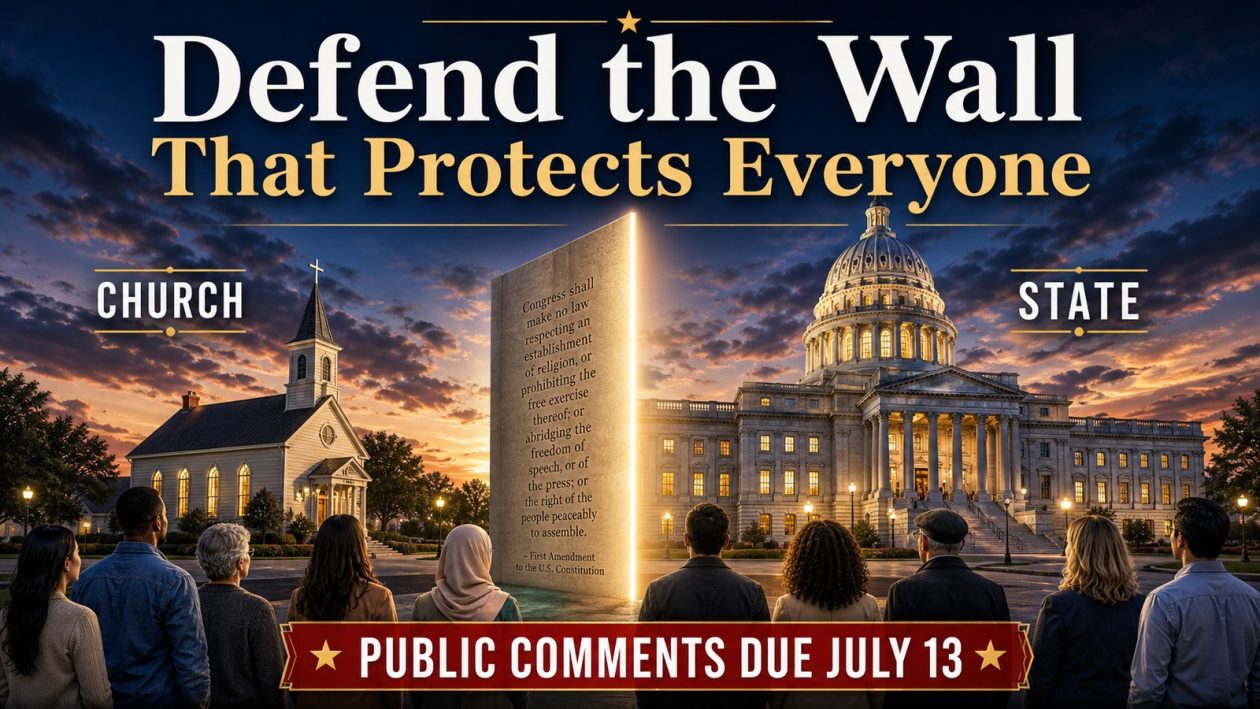
An Appeal to Democratic Officials: Defend the Wall That Protects Everyone

Urgent public comment deadline
Time left to respond
Days
Hours
Minutes
Seconds

Email your public comment to [email protected] before midnight Eastern Time as Sunday, July 12 turns into Monday, July 13, 2026.

Write your public comment

Use the model letters, but add your own voice.

Choose one theme, personalize it with one or two sentences, and email your comment by Monday, July 13, 2026. Individual comments carry more weight than identical copied letters.

  1. Choose one approach: two jurisdictions, the founders' design, the warning of history, the Adventist testimony, the purity of religion, individual rights, Ten Commandments displays, or a balanced commend-and-caution letter.
  2. Personalize it: add your city and state, faith background, Sabbath accommodation experience, concern for minorities, or family history with religious liberty.
  3. Keep it respectful: firm on principle, courteous in tone, and focused on constitutional and religious-liberty concerns.
  4. Send it: email [email protected].

To Democratic mayors, governors, attorneys general, legislators, and civic leaders: the Religious Liberty Commission's draft report deserves a clear response from officials who believe in pluralism, civil rights, minority protection, and constitutional government.

The public comment window closes Monday, July 13, 2026. Comments may be emailed to [email protected]. This is a moment for state and local leaders to say plainly that religious liberty is not protected by giving civil government more religious authority. It is protected by keeping government from becoming the patron, manager, referee, or enforcer of religion.

Action requested: Democratic officials should submit public comments before the July 13 deadline, issue public statements defending church-state separation, and oppose state or local measures that convert religious doctrine into civil law.

This Is Not an Anti-Religion Appeal

Religious citizens should not be driven from public life. A teacher, nurse, student, business owner, public employee, or elected official does not surrender conscience by entering the public square. Religious expression, worship, and moral conviction deserve robust protection.

But protecting religious people is not the same thing as inviting government to fund, prefer, display, or enforce religion. A free society can protect the religious speech of citizens while still refusing to make civil power the instrument of a religious program. There should be no wall between a religious citizen and public participation. There must remain a wall between ecclesiastical power and civil power.

What the Report Moves Toward

The Commission's report uses the language of religious liberty, but several of its recommendations would move the country toward a more official partnership between government and religion. Among the proposals most relevant to state and local officials are these:

  • DOJ guidance redefining the Establishment Clause and the meaning of separation of church and state.
  • New federal religious-liberty offices, divisions, task forces, reporting portals, investigations, and enforcement strategies.
  • Expanded federal partnerships, grants, funds, and contracts for faith-based institutions.
  • Universal school choice and litigation to ensure public funds may flow to religious schools.
  • Federal support for religious expression in public schools, voluntary prayer or chaplain programs, release-time religious instruction, and Ten Commandments or world-religion posters.
  • Repeal of the Johnson Amendment, which would pull churches and religious nonprofits closer to partisan campaign machinery.

Officials who care about civil rights should read those recommendations carefully. The danger is not simply that religion will have a voice in public life. Religious citizens already have that right. The danger is that government will begin to decide which religious activities deserve public support, which religious symbols represent the public, and which religious voices should be amplified by public authority.

Why Democratic Officials Should Care

Church-state separation is not a secularist weapon against religion. Historically, it has been one of the chief safeguards for minority faiths, religious dissenters, nonbelievers, and churches that refuse political control. It protects Baptists from Congregational establishments, Quakers from Puritan punishment, Jews and Adventists from Sunday-law majorities, Muslims from Christian preference, and Christians themselves from state-managed religion.

Democratic officials often speak the language of pluralism and inclusion. This is where that language must become policy. A government that favors religion today can favor a different religion tomorrow. A government that funds religious work today can regulate it tomorrow. A government that posts religious symbols today can choose among competing religious interpretations tomorrow. The state is not competent to judge religious truth, and it should not be asked to do so.

The Historical Warning

America has already tested church-state union. The result was not liberty. Established colonial churches brought religious taxes, religious tests, exclusion from public privileges, and penalties for dissent. Jefferson's phrase, a "wall of separation between Church and State," was not designed to exile faith from public life. It was meant to protect conscience from civil control. Madison's Memorial and Remonstrance warned against making the civil magistrate a judge of religious truth or using religion as an engine of civil policy.

Sunday laws provide a special warning for state and local leaders. They have often been defended as moral order, social rest, family protection, or public welfare. Yet in practice, religiously shaped rest laws have punished minorities whose Sabbath convictions differed from the majority. In Arkansas in 1885, Seventh-day Adventists were prosecuted for ordinary Sunday labor. J. W. Scoles was prosecuted after working to finish painting a church building. Allen Meeks was pursued for planting potatoes on Sunday. The point is not antiquarian curiosity. It is that civil law can become oppressive when it adopts the calendar and conscience of a religious majority.

The Line Officials Should Draw

Democratic officials should draw a bright constitutional line: protect the free exercise of every citizen, but do not establish, fund, prefer, or enforce religion through civil power.

  • Defend religious speech by private citizens, students, employees, and public officials speaking in their personal capacity.
  • Oppose public funding arrangements that make the state a judge of religious eligibility, mission, doctrine, or usefulness.
  • Reject religious displays or programs that make government appear to speak for one faith tradition.
  • Oppose Sunday-rest or Sabbath legislation, even when repackaged as worker, family, or climate policy, if it burdens ordinary labor, travel, commerce, or Sabbath-keeping minorities.
  • Defend churches from government censorship without turning churches into partisan campaign committees.

Suggested Public Comment

Officials may adapt the following language and send it to [email protected] before the July 13 deadline:

I urge the Religious Liberty Commission to revise any recommendations that diminish the separation of church and state, expand government funding or management of religious activity, encourage government religious displays, or invite partisan campaign machinery into houses of worship. Religious liberty requires both free exercise and non-establishment. Government should protect the rights of religious citizens without becoming the patron, promoter, or referee of religion. The constitutional wall of separation protects believers, nonbelievers, minority faiths, and the public peace.

This is not a left-versus-right question at its root. It is a constitutional question. Will America protect religion by keeping it free, or will it try to honor religion by placing it under political management? Democratic officials should answer now, clearly and publicly: liberty of conscience is for everyone, and the wall that protects it should stand.

1U.S. Department of Justice, Religious Liberty Commission Resources, public comment deadline and email address. 2Draft Report of the Presidential Religious Liberty Commission, June 2026. 3Thomas Jefferson's 1802 letter to the Danbury Baptists, Library of Congress. 4James Madison, Memorial and Remonstrance Against Religious Assessments, 1785. 5Encyclopedia of Seventh-day Adventists, Arkansas-Louisiana Conference history, discussion of Arkansas Sunday-law prosecutions. 6A. T. Jones, Civil Government and Religion, examples of Sunday-law prosecutions including Allen Meeks.

Check out Sources

Share this:

What Constitutes the Church? The Clergy or All Believers?

The Church

For centuries Romanism has taught that the head of the Church is the pope and the cardinals are its body. One of the early reformers, John Huss, wrote a response to this dogma in a book entitled “De Ecclessia“, for which he was condemned and burned at the stake in July 6, 1415. Following are the principal points he presents in answer to this common error; the quote is from the book “Ecclesiastical Empire”:

“We must regard the clerical body as made up of two sects: the clergy of Christ, and those of antichrist. The Christian clergy lean on Christ as their leader, and on his law. The clergy of antichrist lean for the most part, or wholly on human laws and the laws of antichrist; and yet pretend to be the clergy of Christ and of the Church, so as to seduce the people by a more cunning hypocrisy. And two sects which are so directly opposed, must necessarily be governed by two opposite heads with their corresponding laws.

Quoting the words of Christ: “Where two or three are gathered together in my name, I am in the midst of them,” he says: “There, then, would be a true particular Church; and accordingly, where three or four are assembled, up to the whole number of the elect; and in this sense the term Church is often used in the New Testament. Thus all the righteous who now, in the archbishopric of Prague, live under the reign of Christ, and in particular the elect, are the true Church of Prague. We may well be amazed to see with what effrontery those who are most devoted to the world, who live most worldly and abominable lives, most distant from the walk with Christ, and who are most unfruitful in performing the counsels and commandments of Christ, with what fearless effrontery such persons assert, that they are heads, or eminent members of the Church, which is His bride.”

“Christ alone is the all-sufficient Head of the Church. The Church needs no other, and therein consists its unity. If a Christian in connection with Christ were the head of the universal Church, we should have to concede, that such a Christian was Christ himself; or that Christ was subordinate to him, and only a member of the Church. Therefore, the apostles never thought of being aught else than servants of that Head, and humble ministers of the Church, His bride; but no one of them ever thought of excepting himself and asserting that he was the head or the bridegroom of the Church. Christ is the all-sufficient Head of the Church; as He proved during three hundred years of the existence of the Church, and still longer, in which time the Church was most prosperous and happy. The law of Christ is the most effectual to decide and determine ecclesiastical affairs, since God Himself has given it for this purpose. Christ himself is the Rock which Peter professed, and on which Christ founded the Church; which, therefore, will come forth triumphant out of all her conflicts.

“The pope and the cardinals may be the most eminent portion of the Church in respect of dignity, yet only in case they follow more carefully the pattern of Christ and, laying aside pomp and the ambition of the primacy, serve in a more active and humble manner their mother, the Church. But proceeding in the opposite way, they become the abomination of desolation: a college opposed to the humble college of the apostles of our Lord Jesus Christ. Why should not Christ, who, in the holy supper, grants to believers the privilege of participating in a sacramental and spiritual manner of himself, — why should not He be more present to the Church, than the pope, who, living at a distance of more than eight hundred miles from Bohemia, can not by himself act directly on the feelings and movements of the faithful in Bohemia, as it is incumbent on the head to do! It would be enough, then, to say that the pope is a representative of Christ; and it would be well for him, if he were a faithful servant, predestined to a participation in the glory of his Head, — Jesus Christ.

“The papacy, by which a visible head was given to the Church, derived its origin from the emperor Constantine; for, until the gift of Constantine, the pope was but a colleague of the other bishops. If the Almighty God could not give other true successors of the apostles than the pope and the cardinals, it would follow that the power of the emperor, a mere man, by whom the pope and the cardinals were instituted, had set limits to the power of God. Since, then, the Almighty God is able to take away the prerogatives of all those emperors, and to bring back His Church once more to the condition in which all the bishops shall be on the same level, as it was before the gift of Constantine, it is evident that he can give others besides the pope and the cardinals, to be true successors of the apostles, so as to serve the Church as the apostles served it.

“It is evident that the greatest errors and the greatest divisions have arisen by occasion of this [visible] head of the Church, and that they have gone on multiplying to this day. For, before such a head had been instituted by the emperor, the Church was constantly adding to her virtues; but after the appointing of such a head the evils have continually mounted higher. And there will be no end to all this, until this head, with its body, be brought back to the rule of the apostles. Christ can better govern His Church by His true disciples scattered through all the world, without such monsters of supreme heads. The theological faculty have called the pope ‘the secure, never-failing, and all-sufficient refuge for his Church.’ No created being can hold this place. This language can be applied only to Christ. He alone is the secure, unfailing, and all-sufficient refuge for His Church, to guide and enlighten it. ‘Without me ye can do nothing.’ John 15.5.

“It injures not the Church, but benefits it, that Christ is no longer present to it after a visible manner; since He himself says to His disciples, and, therefore, to all their successors (John 16:7): ‘It is good for you that I go away; for if I went not away, the Comforter would not come to you; but if I go, I will send Him unto you.’ It is evident from this, as the truth itself testifies, that it is a salutary thing for the Church militant that Christ should ascend from it to heaven, that so His longer protracted bodily and visible presence on earth might not be prejudicial to her. Therefore, the Church is sufficiently provided for in the invisible guidance, and should need no visible one by which she might be made dependent. Suppose, then, that the pope who walks visibly among men, were as good a teacher as that promised Spirit of Truth, for which one need not to run to Rome or Jerusalem, since he is everywhere present, in that He fills the world [even then such visible head would not be “good” for the Church]. Suppose also that the pope were as secure, unfailing, and all-sufficient a refuge for all the sons of the Church as that Holy Spirit; it would follow that you supposed a fourth person in the divine Trinity.

“This Spirit, in the absence of a visible pope, inspired prophets to predict the future bridegroom of the Church, strengthened the apostles to spread the gospel of Christ through all the world, led idolaters to the worship of one only God, and ceases not, even until now, to instruct the bride and all her sons, to make them certain of all things, and guide them in all things that are necessary for salvation. As the apostles and priests of Christ ably conducted the affairs of the Church in all things necessary to salvation, before the office of pope had yet been introduced, so they will do it again if it should happen, it is quite possible it may, that no pope should exist, until the day of judgment; for Christ is able to govern His Church, after the best manner, by His faithful presbyters, without a pope. The cardinals, occupied with worldly business, can not teach and guide, by sermons, in the articles of faith and the precepts of the Lord, the members of the universal Church and of our Lord Jesus Christ. But the poor and lowly priests of Christ, who have put away out of their hearts all ambition, and all ungodliness of the world, being themselves guided by the grace of our Lord Jesus Christ,teach and guide the sons of the Church, quickened by the grace of the Holy Spirit, and give them certainty in the articles of faith and the precepts necessary to salvation. The Church has all that it needs in the guidance of the Holy Spirit, and ought to require nothing else; nothing else can be a substitute for that.”

Now, what is the church or body of Christ?

  • 1 Corinthians 3:11 – “The head of every man is Christ”
  • Ephesians 2:20 – “We are members of His body, of His flesh, and of His bones”
  • Colossians 1:18 – “He [Christ] is the head of the body”

Read the following extract from The Present Truth, Feb. 26, 1903:

WHAT IS THE CHURCH?

Not to multiply words, we find from Eph. 1:22, 23, that the church is the body of Christ. This body is composed of all who are Christ’s. The church is also called the house of God (1 Tim. 3:15), “whose house are we, if we hold fast the confidence and the rejoicing in the hope firm unto the end.” Heb. 3:6. The church is not composed of “the clergy,” so called, that is, of the ministry; for we read: “Ye are the body of Christ, and members in particular. And God had set some in the church, first apostles, secondarily prophets, thirdly teachers, after that miracles, then gifts of healings, helps, governments, diversities of tongues.” 1 Cor. 12:27, 28. “For as we have many members in one body, and all members have not the same office; so we, being many, are one body in Christ, and every one members one of another.” Rom. 12:4, 5.
The Greek word which is rendered “church,” is a compound word meaning “called out.” We have the word in the adjective “ecclesiastical.” God called Israel of old out of Egypt, and they formed “the church in the wilderness.” Acts 7:38. All who are in Christ have been called out of Egypt; for it is written, and fulfiled in Christ, “Out of Egypt have I called My Son.” Matt. 2:14, 15. Christ is “that great Shepherd of the sheep” (Heb. 13:20), and He stands and calls His sheep and as they hear His voice they come to Him. As they thus assemble about Him, they form His flock or congregation, and this is the word that really ought always to be used, instead of “church.” The names of “the general assembly and church [congregation] of the Firstborn” are “written in heaven” (Heb. 12:23); but whenever on earth there are two or three, or more, of “like precious faith” in the same neighbourhood, they naturally come together for mutual edification; and each one of these fragments of “the general assembly” is called a church, or congregation, since the life of the whole is in each part. “Unto every one of us is given grace according to the measure of the gift of Christ.” Eph. 4:7.


Share this:

Liberty countdown…

September 24, 2015, will be one of the most regretful days of American history. This day will be eternally remembered as the day in which this free country, who prized civil and religious freedoms as more important than life itself, has, through its legislative branch, opened its arms to receive the representative of the Catholic Church — a system which historically has been the enemy of religious freedom and liberty of conscience.

“The Constitution of the United States guarantees liberty of conscience. Nothing is dearer or more fundamental. Pope Pius IX., in his Encyclical Letter of August 15, 1854, said: ‘The absurd and erroneous doctrines or ravings in defense of liberty of conscience, are a most pestilential error—a pest, of all others, most to be dreaded in a State.’ The same pope, in his Encyclical Letter of December 8, 1864, anathematized ‘those who assert the liberty of conscience and of religious worship,’ also ‘all such as maintain that the church may not employ force.’” (Josiah Strong, Our Country, 1885, p. 47).

The laws and principles of the Church of Rome are absolutely antagonistic to the laws and principles of the United States of America. History has been stained with the crimes committed by Rome. It was to prevent the despotic rule of the Church that the framers of the Constitution established a clear separation between church and State. The Protestant Reformation made it possible for people to follow their conscience in matters of religious duty, but the Romish Church, seeking to bring back those countries which had broken its yoke, launched the counter-reformation, and set itself to accomplish by craftiness what it could not do by force. Unfortunately, Protestants seem to be blindfolded to what the Papal Church is endeavoring. They imagine that the Church has changed, but it has not. It will never relinquish its claim to infallibility.

“The pacific tone of Rome in the United States does not imply a change of heart. She is tolerant where she is helpless. Says Bishop O’Connor: ‘Religious liberty is merely endured until the opposite can be carried into effect without peril to the Catholic world.’” (Idem).

By invitation of John Boehner, the Speaker for the House, Pope Francis will “make history as the first Pope to ever address a joint meeting of Congress”! Can you imagine if the founding fathers could see this happening? What could be worse than that? Religious freedom was as dear to themselves as their civil freedom. Protestantism and Republicanism were the pillars that made this country achieve its greatness. But, as someone has said, “ignorance is the enemy of Freedom”. If you don’t know what Romanism really is, you will most likely be charmed by it. But, fortunately enough, history has preserved the evil deeds this system has perpetrated. Books such as “History of Protestantism”, by James A. Wylie, “Ecclesiastical Empire”, by A. T. Jones, “Fifty Years in the Church of Rome”, by Father Chiniquy, and a host of other books, will serve to enlighten anyone who whishes to know the character of this despotic system.

It does not take long to find that wherever the Romish Church has had its power in unrestricted sway, the fires of persecution burned hot against those who would not yield their God-given right, the right of conscience and of religious liberty. The Papal system has murdered more than 60 million people in the Middle Ages, and, should it receive the same power again, that number might seem a small fraction of the slain. For more than fifteen hundred years, it has proved again and again that it is fundamentally contrary to liberty. By torturing those who disagreed with them, and burning at the stake those who would not recant, this tyrant has silenced the protest of the “dissenters”.

Then what reason can be given for the Senate and House of Representatives of the United States to receive the leader of a system so contrary to civil and religious freedom? And by what misfortune is he speaking to the LEGISLATIVE branch of this country? Do they suppose that they can now befriend this despotic system? Do they even fathom that by this act they will, in future developments, throw this country into a religious despotism? Should we be silent when we see the danger approaching? Should we allow it without any protest? Absolutely not!

We, the free people of this country, do most decidedly PROTEST against this attempt against liberty! We protest against the Senate and the House of Representatives inviting the Bishop of Rome to speak to them. We protest against the breaking the safeguards of this free Republic. We protest against this union with the papacy and we warn all the people of the world that this will be one of the last steps before Earth’s final destruction. Free America will join hands with the enemies of freedom, and will form an image to the beast (Revelation 13:14). Then, this country will become the persecutor, and Protestants will too late regret this unwise step in inviting the enemies of Christ to be their friends.

What can you do:

  1. Call your representative and let him know that you are against this attack on freedom: http://www.house.gov.
  2. Share this PROTEST with as many people as you can. We have to act now!
  3. Pray that God will protect His people from this unholy and disastrous alliance.
Share this:

The Danger

It is dangerous to forget. It is a safeguard to remember. History is a lesson book that displays an abundance of trial experiments of frightful human attempts to exalt themselves and control the minds of others.

Religious Liberty is a divine gift to humanity. It is essential to the full development of human beings. This liberty has come to us today at a very high price. It cost the lives of tens of millions of people that would not yield their conscience to another person.

This history is to be kept in mind if we are to avoid repeating it and plunging the world into another phase of the Dark Ages, only that this time it will be worse, for humanity has developed improved methods of coercion and investigation.

Watch out, sentinels! When you see the doom approaching, fear not to lift up your voices. If we be quiet now, we may not have a chance to say anything else.

Share this: