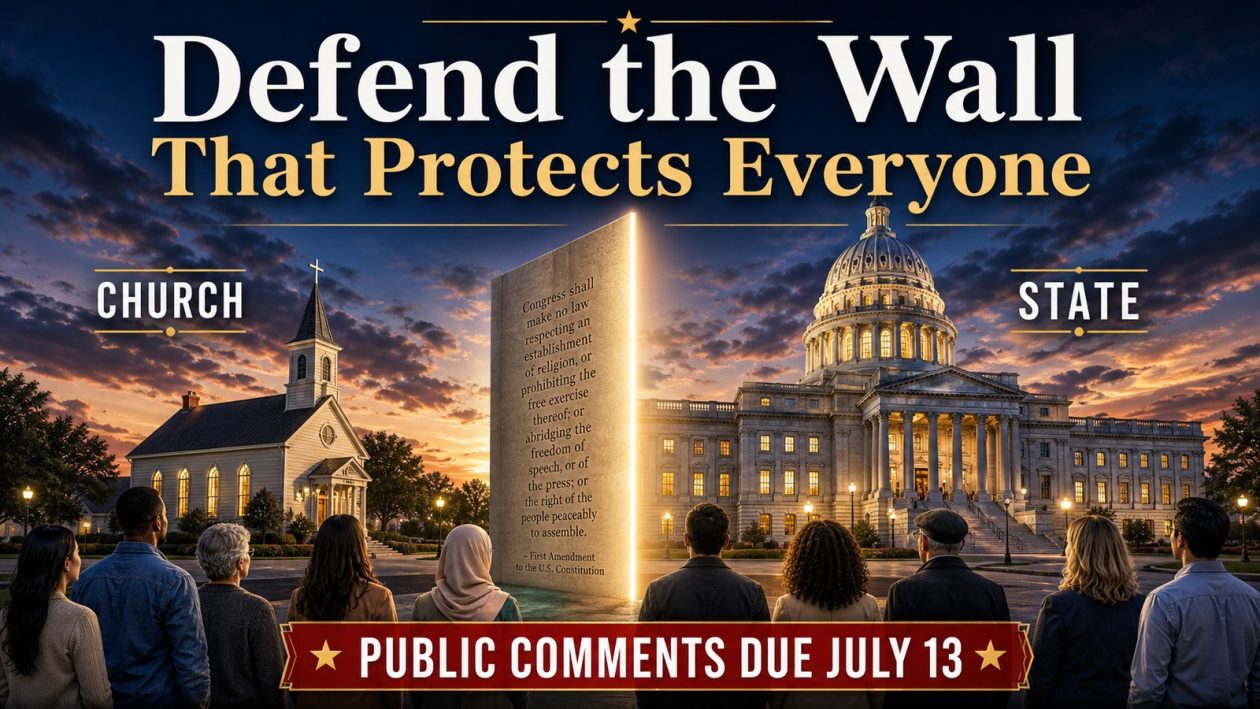
Email your public comment to [email protected] before midnight Eastern Time as Sunday, July 12 turns into Monday, July 13, 2026.
Use the model letters, but add your own voice.
Choose one theme, personalize it with one or two sentences, and email your comment by Monday, July 13, 2026. Individual comments carry more weight than identical copied letters.
- Choose one approach: two jurisdictions, the founders' design, the warning of history, the Adventist testimony, the purity of religion, individual rights, Ten Commandments displays, or a balanced commend-and-caution letter.
- Personalize it: add your city and state, faith background, Sabbath accommodation experience, concern for minorities, or family history with religious liberty.
- Keep it respectful: firm on principle, courteous in tone, and focused on constitutional and religious-liberty concerns.
- Send it: email [email protected].
To Democratic mayors, governors, attorneys general, legislators, and civic leaders: the Religious Liberty Commission's draft report deserves a clear response from officials who believe in pluralism, civil rights, minority protection, and constitutional government.
The public comment window closes Monday, July 13, 2026. Comments may be emailed to [email protected]. This is a moment for state and local leaders to say plainly that religious liberty is not protected by giving civil government more religious authority. It is protected by keeping government from becoming the patron, manager, referee, or enforcer of religion.
This Is Not an Anti-Religion Appeal
Religious citizens should not be driven from public life. A teacher, nurse, student, business owner, public employee, or elected official does not surrender conscience by entering the public square. Religious expression, worship, and moral conviction deserve robust protection.
But protecting religious people is not the same thing as inviting government to fund, prefer, display, or enforce religion. A free society can protect the religious speech of citizens while still refusing to make civil power the instrument of a religious program. There should be no wall between a religious citizen and public participation. There must remain a wall between ecclesiastical power and civil power.
What the Report Moves Toward
The Commission's report uses the language of religious liberty, but several of its recommendations would move the country toward a more official partnership between government and religion. Among the proposals most relevant to state and local officials are these:
- DOJ guidance redefining the Establishment Clause and the meaning of separation of church and state.
- New federal religious-liberty offices, divisions, task forces, reporting portals, investigations, and enforcement strategies.
- Expanded federal partnerships, grants, funds, and contracts for faith-based institutions.
- Universal school choice and litigation to ensure public funds may flow to religious schools.
- Federal support for religious expression in public schools, voluntary prayer or chaplain programs, release-time religious instruction, and Ten Commandments or world-religion posters.
- Repeal of the Johnson Amendment, which would pull churches and religious nonprofits closer to partisan campaign machinery.
Officials who care about civil rights should read those recommendations carefully. The danger is not simply that religion will have a voice in public life. Religious citizens already have that right. The danger is that government will begin to decide which religious activities deserve public support, which religious symbols represent the public, and which religious voices should be amplified by public authority.
Why Democratic Officials Should Care
Church-state separation is not a secularist weapon against religion. Historically, it has been one of the chief safeguards for minority faiths, religious dissenters, nonbelievers, and churches that refuse political control. It protects Baptists from Congregational establishments, Quakers from Puritan punishment, Jews and Adventists from Sunday-law majorities, Muslims from Christian preference, and Christians themselves from state-managed religion.
Democratic officials often speak the language of pluralism and inclusion. This is where that language must become policy. A government that favors religion today can favor a different religion tomorrow. A government that funds religious work today can regulate it tomorrow. A government that posts religious symbols today can choose among competing religious interpretations tomorrow. The state is not competent to judge religious truth, and it should not be asked to do so.
The Historical Warning
America has already tested church-state union. The result was not liberty. Established colonial churches brought religious taxes, religious tests, exclusion from public privileges, and penalties for dissent. Jefferson's phrase, a "wall of separation between Church and State," was not designed to exile faith from public life. It was meant to protect conscience from civil control. Madison's Memorial and Remonstrance warned against making the civil magistrate a judge of religious truth or using religion as an engine of civil policy.
Sunday laws provide a special warning for state and local leaders. They have often been defended as moral order, social rest, family protection, or public welfare. Yet in practice, religiously shaped rest laws have punished minorities whose Sabbath convictions differed from the majority. In Arkansas in 1885, Seventh-day Adventists were prosecuted for ordinary Sunday labor. J. W. Scoles was prosecuted after working to finish painting a church building. Allen Meeks was pursued for planting potatoes on Sunday. The point is not antiquarian curiosity. It is that civil law can become oppressive when it adopts the calendar and conscience of a religious majority.
The Line Officials Should Draw
Democratic officials should draw a bright constitutional line: protect the free exercise of every citizen, but do not establish, fund, prefer, or enforce religion through civil power.
- Defend religious speech by private citizens, students, employees, and public officials speaking in their personal capacity.
- Oppose public funding arrangements that make the state a judge of religious eligibility, mission, doctrine, or usefulness.
- Reject religious displays or programs that make government appear to speak for one faith tradition.
- Oppose Sunday-rest or Sabbath legislation, even when repackaged as worker, family, or climate policy, if it burdens ordinary labor, travel, commerce, or Sabbath-keeping minorities.
- Defend churches from government censorship without turning churches into partisan campaign committees.
Suggested Public Comment
Officials may adapt the following language and send it to [email protected] before the July 13 deadline:
I urge the Religious Liberty Commission to revise any recommendations that diminish the separation of church and state, expand government funding or management of religious activity, encourage government religious displays, or invite partisan campaign machinery into houses of worship. Religious liberty requires both free exercise and non-establishment. Government should protect the rights of religious citizens without becoming the patron, promoter, or referee of religion. The constitutional wall of separation protects believers, nonbelievers, minority faiths, and the public peace.
This is not a left-versus-right question at its root. It is a constitutional question. Will America protect religion by keeping it free, or will it try to honor religion by placing it under political management? Democratic officials should answer now, clearly and publicly: liberty of conscience is for everyone, and the wall that protects it should stand.
1U.S. Department of Justice, Religious Liberty Commission Resources, public comment deadline and email address. 2Draft Report of the Presidential Religious Liberty Commission, June 2026. 3Thomas Jefferson's 1802 letter to the Danbury Baptists, Library of Congress. 4James Madison, Memorial and Remonstrance Against Religious Assessments, 1785. 5Encyclopedia of Seventh-day Adventists, Arkansas-Louisiana Conference history, discussion of Arkansas Sunday-law prosecutions. 6A. T. Jones, Civil Government and Religion, examples of Sunday-law prosecutions including Allen Meeks.Check out Sources
- 1
- 2
- 3
- 4
- 5
- 6