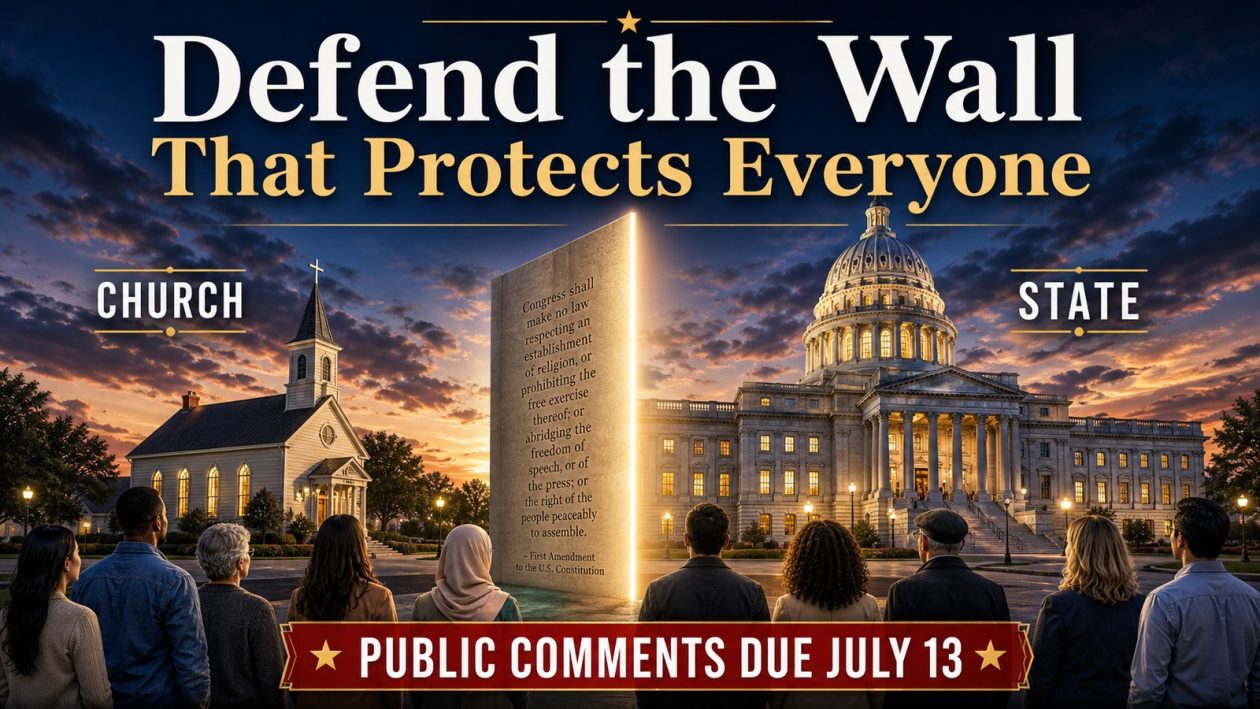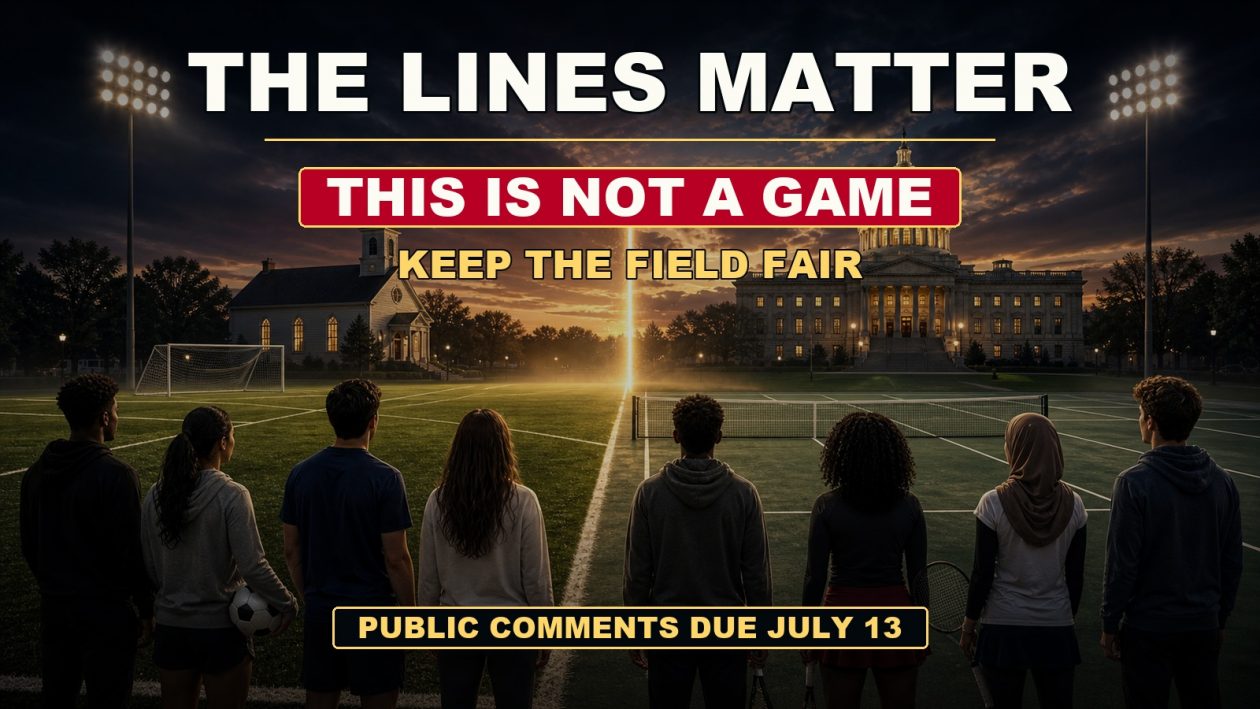
Email your public comment to [email protected] before midnight Eastern Time as Sunday, July 12 turns into Monday, July 13, 2026.
This summer, millions of people are watching the World Cup across North America and Wimbledon in England. We understand instantly why rules matter. The lines matter. The referee matters. The official cannot quietly play for one side and still call it a fair match.
Religious liberty works the same way.
When government takes sides in religion, it stops being the referee and steps onto the field. That may feel harmless when the government favors your side. But the same power that favors one faith today can burden another tomorrow.
This is not a game. The stakes are conscience, worship, minority rights, and the freedom of every person to answer to God without Caesar standing in between.
Add your voice before July 13.
You do not need to sound like a politician. Choose one point, write personally, and ask the Commission to protect free exercise without weakening church-state separation.
The Lines Are There for a Reason
In sports, boundary lines are not decoration. They tell everyone where the game is fair, where the official must be neutral, and when power has crossed into the wrong place.
Liberty has lines too.
If we care about our neighbors, we do not ask government to pressure their conscience. If we care about our faith, we do not hand it to politicians to manage. If we care about liberty, we defend it when it protects people who are different from us.
That is why church-state separation is not anti-religious. It is one of the ways a free society keeps the field fair. It keeps the state from choosing winners and losers in matters of conscience.
The Rule Is Simple
The game only works when the referee is neutral.
The republic only works when civil government stays civil.
Government may protect people from violence, coercion, discrimination, and fraud. It may defend the right of every person to worship freely. But it may not command worship, sponsor religious observance, interpret sacred law, or use public power to promote one faith's practices over another's.
That line protects everyone: the Christian, the Jew, the Muslim, the Buddhist, the Hindu, the atheist, the student who is still searching, and the minority believer whose convictions are not popular.
Why This Matters Right Now
Public comments on the Religious Liberty Commission draft report are due Monday, July 13, 2026. That deadline comes immediately after Wimbledon ends on July 12 and while the World Cup is being played across North America, including the United States.
The Commission needs to hear from younger voices, students, young professionals, church members, and first-time public commenters who understand that religious liberty is not a culture-war trophy. It is a shield for every conscience.
- Do not weaken the Establishment Clause.
- Do not make public schools instruments for government-sponsored religion.
- Do not use the state to interpret or promote sacred law.
- Do strengthen free exercise, conscience protections, and religious accommodation for everyone.
Free exercise and non-establishment are not enemies. They are one shield.
A. T. Jones Saw the Danger
In 1888, A. T. Jones testified before the United States Senate against national Sunday legislation. His point was direct: civil government is civil. It has no rightful authority over religious observance.
Jones argued from the words of Jesus: "Render therefore unto Caesar the things which are Caesar's; and unto God the things that are God's." That is not a slogan. It is a boundary.
Some things belong to Caesar: public order, civil rights, protection from harm, equal justice under law.
Some things do not belong to Caesar: worship, conscience, sacred time, duties owed to God.
When government crosses that line, it may begin with good intentions. But history shows where it leads. The power to favor religion becomes the power to control religion.
What You Can Do in Ten Minutes
You do not need to write a legal brief. You do not need to sound like a politician. You need to speak clearly, respectfully, and personally.
- Choose one point that matters to you.
- Write three to six short paragraphs.
- Add one personal sentence about why religious liberty matters to you.
- Ask the Commission to protect free exercise without weakening church-state separation.
- Email it before the deadline.
Send your public comment to [email protected].
A Short Comment You Can Adapt
Dear Members of the Religious Liberty Commission,
I am writing as a young citizen who believes religious liberty is protected best when government does not take sides in matters of worship and conscience.
The state should protect every person's right to believe, worship, rest, speak, and live according to conscience. But civil government should not sponsor religious observance, interpret sacred law, or use public schools to promote religion.
Free exercise and church-state separation belong together. A government with no authority to sponsor religion has no authority to suppress it. That protects people of every faith and people of no faith.
I urge the Commission to strengthen religious accommodation and conscience protections while preserving the Establishment Clause and the separation of church and state.
Respectfully,
[Name]
[City, State]
For a fuller argument, read What Patriotism Requires Now: Defend Religious Liberty Before July 13.
Sources
- FIFA, FIFA World Cup 2026 host cities and dates
- Wimbledon, Dates for future Championships